
Views: 0 Author: Site Editor Publish Time: 2026-02-21 Origin: Site


If you’ve ever watched a field being treated for weeds, insects, or crop diseases, you’ve already seen the value of agricultural sprayers in action. Sprayers are one of the most practical tools in modern farming because they help growers apply products—like fertilizers, herbicides, pesticides, and foliar nutrients—evenly, efficiently, and at the right dosage. That “right dosage” matters more than many people realize. Too little application can reduce effectiveness and waste labor. Too much can damage crops, increase cost, and create environmental risk. So when customers ask us, “What is an agricultural sprayer?” we usually answer with a simple idea: an agricultural sprayer is a system designed to deliver the correct liquid to the correct target, with the correct droplet size, at the correct rate.
At Taizhou Kesiwo Garden Tools Co., Ltd., we work with sprayer products used across farms, orchards, gardens, and smallholdings. In this article, we’ll explain what an agricultural sprayer is, the main types, how the key parts work together, and how to choose a sprayer that fits your crop, terrain, and daily workflow. We’ll keep the language practical and include tables to make the differences easy to compare.
An agricultural sprayer is a tool or machine that applies liquid solutions—such as plant protection chemicals, fertilizers, and disinfectants—by breaking the liquid into droplets and distributing it over a target area (plants, soil, or surfaces). Sprayers may be manually operated or powered (electric, battery, gasoline, tractor PTO), and they range from small handheld units to large boom sprayers used in broad-acre farming.
Better coverage on leaves, stems, and soil
More consistent dosage across the field or orchard
Reduced labor time compared with manual methods
Improved efficiency (less chemical waste and fewer re-sprays)
Agricultural sprayers are used wherever liquid application supports plant health, yield, or biosecurity. Common uses include:
Weed control (herbicide spraying)
Insect control (insecticide application)
Disease prevention (fungicides and protective sprays)
Foliar feeding (nutrients applied directly to leaves)
Growth support (biostimulants or plant regulators)
Sanitation (disinfection in livestock areas or equipment cleaning)
The same sprayer can often handle multiple applications, but nozzle choice, pressure, and dilution management become especially important when switching tasks.
Most sprayers operate on the same basic principle:
Tank holds the liquid mixture
Pump creates flow and pressure
Hose, lance, or boom delivers the liquid
Nozzle atomizes liquid into droplets
Operator controls direction and speed to hit the target evenly
Component | What It Does | Why It Matters |
Tank | Stores solution | Size affects refill frequency and coverage per fill |
Pump | Moves liquid + builds pressure | Determines flow stability and spray strength |
Hose/Lance/Boom | Delivers liquid | Controls reach, coverage width, and handling |
Nozzle | Creates droplet size and spray pattern | Strongly affects drift, coverage, and efficiency |
Filter/Strainer | Keeps debris out | Prevents clogging and uneven spraying |
Pressure control | Adjusts output | Helps match droplet size to task and conditions |
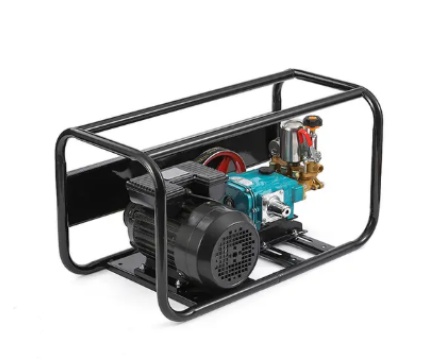
In practical farm work, many users prefer power sprayers because they deliver more stable pressure, wider coverage, and higher efficiency than manual units—especially when spraying becomes a frequent routine. To make selection easier, we usually classify agricultural sprayers into four common types based on how the power sprayer is carried and used: Knapsack Power Sprayers, Portable Power Sprayers, Frame Power Sprayers, and Trolley Power Sprayers. Each type is designed for different terrain, workload, and spraying distance.
A knapsack power sprayer is carried on the back, combining mobility with powered pressure output. It’s a popular choice for small farms, orchards, slopes, and areas where vehicles cannot enter easily. Because the operator moves with the sprayer, it works well for spot spraying, row-by-row treatment, and uneven ground operations.
A portable power sprayer is designed for easy movement and flexible placement. It can be carried by hand or placed near the working area while spraying through a hose and lance. This type is suitable when you want stronger output than a knapsack unit but still need portability for scattered tasks such as garden crops, greenhouse edges, or mixed planting zones.
A frame power sprayer is built on a sturdy frame structure, making it more stable during operation and easier to integrate with larger tanks or longer hoses. This type is often used for longer-duration spraying where consistent performance matters, such as orchard blocks, farm perimeter spraying, or repeated crop protection schedules. The frame design helps with durability and organized installation of key components.
A trolley power sprayer places the sprayer system on wheels, allowing you to carry more liquid and reduce operator fatigue. It’s ideal for farms where paths are relatively flat and where you need extended spraying time without frequent refilling. Many users choose trolley models for medium-size coverage work, especially when water supply and spray routes are convenient.
Type | Best For | Key Advantage | Watch-Out |
Knapsack Power Sprayers | Orchards, hills, narrow rows | Highest mobility | Operator load/fatigue |
Portable Power Sprayers | Mixed tasks, greenhouse edges | Flexible placement | Tank capacity may be limited |
Frame Power Sprayers | Longer runs, stable operation | Strong structure, consistent output | Less convenient to move frequently |
Trolley Power Sprayers | Flat farms, longer coverage | Larger capacity, less carrying | Needs workable ground paths |
Two sprayers with the same tank size can perform very differently depending on nozzle choice. Nozzles control:
Droplet size (fine vs coarse)
Spray angle and pattern (fan, cone, adjustable)
Coverage vs drift balance
Goal | Preferred Droplet Tendency | Why |
Better leaf coverage | Finer droplets | More contact points on surfaces |
Reduce drift in wind | Coarser droplets | Heavier droplets travel less |
Penetrate canopy | Balanced, task-specific | Needs enough energy to reach interior leaves |
Spot spraying weeds | Controlled pattern | Accuracy prevents waste and crop injury |
Nozzle choice is one of the fastest ways to improve results without changing your whole sprayer.
Here’s a practical checklist we use with buyers:
Herbicides in open fields are different from fungicides in dense orchard canopies.
This determines tank size and whether portability or speed matters more.
Hills and orchards often favor backpack units; flat large areas favor boom sprayers.
If you need uniform coverage, stable pressure control and reliable nozzles are essential.
Frequent spraying usually justifies more comfortable, efficient systems.
Good sprayer performance comes from consistent care. Always rinse after each use, especially after chemicals, to prevent corrosion, residue buildup, and nozzle blockage. Clean filters and strainers regularly so flow stays stable and pressure readings remain accurate. Check nozzles for wear, because worn nozzles change flow rate and spray pattern—often causing invisible over-application. Inspect hoses and seals for leaks or soft spots, since small leaks reduce pressure and create uneven coverage. Finally, store your sprayer dry and protected from direct sun and freezing temperatures to extend seal and hose life. A small clog or leak can quietly ruin application uniformity—so maintenance is also performance control.
So, what is an agricultural sprayer? It’s a tool designed to apply liquids accurately and efficiently—helping farmers protect crops, manage weeds and pests, and improve yields while controlling cost and reducing waste. The right sprayer is not only about tank size. It’s about matching your crop type, terrain, and application goals with the correct sprayer format, pump performance, and nozzle setup. Whether you’re treating a small orchard, managing a greenhouse, or handling routine crop protection on a farm, choosing the right agricultural sprayers can make your work faster, safer, and more consistent. If you’d like to explore agricultural sprayer options, understand which configuration fits your daily use, or compare features for different farm scenarios, you can learn more through Taizhou Kesiwo Garden Tools Co., Ltd. and contact our team for product details and practical selection support.
An agricultural sprayer is used to apply liquids like herbicides, insecticides, fungicides, foliar fertilizers, and disinfectants evenly across crops, soil, or surfaces.
Backpack sprayers (manual or battery) are often a strong choice for small farms because they are portable, flexible, and effective for spot spraying and row-by-row work.
Choose based on your goal: finer droplets for coverage, coarser droplets to reduce drift, and the correct spray pattern for your target area. Nozzle selection strongly affects results.
Calibration ensures you apply the right amount of product. It prevents waste, improves effectiveness, reduces crop risk, and helps you maintain consistent results across the field.


