
Views: 0 Author: Site Editor Publish Time: 2026-09-03 Origin: Site


Precision is everything in modern farming. Applying the exact amount of water, chemical fertilizers, or pesticides directly decides the success of your harvest. Choosing the wrong equipment not only wastes money but also actively harms your crops through inconsistent application. To navigate the crowded equipment market, this comprehensive agricultural sprayer buying guide will walk you through the essential technical specifications and operational considerations required to make an informed purchasing decision. Whether you manage a small greenhouse or a vast commercial field, selecting the right tool is a critical step toward sustainable and profitable cultivation.
The primary function of any agricultural spraying equipment is the precise distribution of liquid solutions. Whether you are applying herbicides, insecticides, or fungicides, even coverage is mandatory to prevent crop disease and stimulate uniform growth. If a machine produces inconsistent pressure or improper droplet sizes, it can lead to severe chemical burn on certain plant leaves. Meanwhile, adjacent foliage might be left entirely unprotected against pests. Proper equipment ensures that active ingredients reach the targeted zones at the exact concentration required by agricultural standards.
Chemical inputs represent a significant portion of a farm's recurring seasonal budget. An inefficient sprayer that leaks, drips, or produces excessive drift causes expensive synthetic fertilizers and commercial pesticides to evaporate or wash away. By selecting a unit with precise flow control and the correct nozzle output, farmers can drastically reduce chemical waste. Furthermore, matching the tank size and power source to the field size reduces the manual labor hours spent refilling. This efficiency accelerates your return on investment.
Modern agricultural practices demand strict adherence to environmental conservation protocols. Precision application is a critical component of soil conservation and groundwater protection. When chemicals are over-applied due to faulty equipment, the excess liquid runs off into local water systems and causes ecological damage. High-quality models with adjustable pressure settings allow operators to minimize spray drift and prevent soil runoff effectively.
Looking at recent industry trends, market analyses highlight a massive shift toward precision application technologies. As environmental regulations tighten globally, farm operators are increasingly moving away from high-volume, indiscriminate spraying. Instead, the focus is shifting toward targeted, low-drift systems equipped with smart flow-control mechanisms. This evolution not only aligns with sustainable land management but also mitigates the rising costs of agricultural inputs. Modern growers are prioritizing equipment that offers variable rate application, ensuring that every drop of chemical is utilized efficiently without compromising the surrounding ecosystem.
Navigating the market requires a clear understanding of the mechanical differences between equipment categories. Below is an objective breakdown of the primary types utilized in commercial and private farming.
These are backpack-style units worn directly by the operator. While traditional models require manual hand-pumping, modern Knapsack Power Sprayers are equipped with small internal combustion engines or lithium-ion batteries. These power sources generate consistent pump pressure automatically. They are indispensable for small to medium-sized farms, highly uneven terrain, and targeted spot treatments. Picture walking through narrow, densely planted vineyard rows after a heavy spring rain where a tractor simply cannot fit. In such scenarios, a backpack unit provides the necessary agility.
These compact, highly mobile motorized pump units operate differently. Instead of featuring a built-in liquid tank strapped to your back, Portable Power Sprayers draw liquid via a suction hose from a separate, larger external drum. The operator only holds the spray wand and the high-pressure discharge hose. Specifically, this setup is ideal for orchards and commercial greenhouses. You can leave a heavy fifty-gallon drum stationary at the end of a row while you walk deep into the trees to apply treatments. This greatly saves immense physical strain.
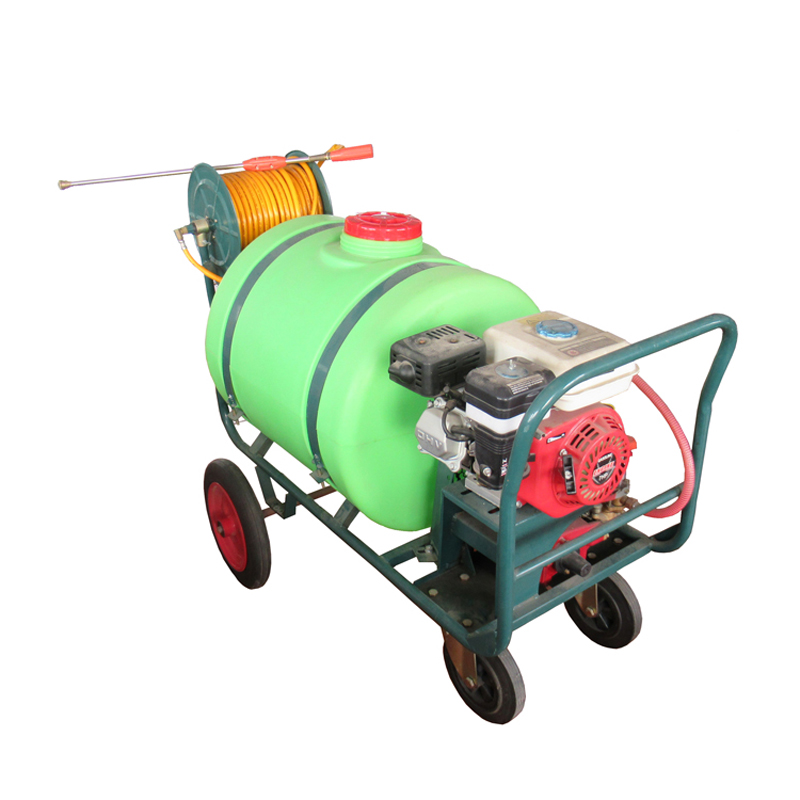
Integrated systems where the tank, motorized pump, and hose reel are mounted on a wheeled cart are known as Trolley Power Sprayers. They offer significantly larger tank capacities than backpack models but do not require a tractor to operate. In addition, they provide high mobility across medium-to-large flat farms, paved commercial plant nurseries, and professional landscaping sites. This allows for extended working times without operator fatigue.
These heavy-duty, large-scale systems are designed to be mounted onto the three-point hitch of a tractor or towed behind it. Utilizing long horizontal booms fitted with multiple nozzles, they cover wide swaths of land simultaneously. They remain the undisputed choice for massive agricultural fields and broad-acre farming, such as wheat, corn, or soybean operations.
The most frequent application is the deployment of insecticides to eliminate crop-destroying insects and fungicides to prevent mold. For this task, a machine must be capable of producing a fine mist. Fine droplets adhere much better to the underside of plant leaves. This is precisely where pests and fungal spores typically hide and reproduce.
When applying herbicides to clear unwanted vegetation, the objective shifts completely. Unlike pest control, weed management requires larger, heavier liquid droplets. When the wind picks up in the afternoon, fine mists are easily caught and carried onto your primary, healthy crops. This dangerous phenomenon is known as drift. Adjustable pressure systems keep the spray targeted and strictly localized.
Foliar feeding is a highly efficient method of delivering liquid nutrients directly to plant leaves for rapid absorption. Equipment is also used for root drenching, delivering fertilizer directly to the base of the plant. Because synthetic fertilizers can be highly corrosive to standard metals, this specific application demands chemically resistant internal components.
Beyond chemical distribution, high-pressure units serve excellent secondary utility roles. They can be utilized for light, targeted irrigation during unexpected dry spells, particularly in nurseries. Furthermore, gas-powered models with high pressure output excel at power-washing mud off farm machinery, cleaning out livestock pens, and sanitizing poultry housing.
Choosing the right tank size requires calculating your standard spray volume. This prevents the inefficiency of constant refilling or the physical strain of carrying unnecessary weight. Keep in mind that just four gallons of water weigh over thirty-three pounds. For continuous coverage over three to five acres, a high-capacity trolley system is far more appropriate than a standard backpack. Additionally, the tank must be constructed from High-Density Polyethylene. This material features UV stabilizers to prevent the plastic from cracking under prolonged sunlight exposure.
The pump is the mechanical heart of the machine. Diaphragm pumps utilize a flexible rubber membrane to create suction. Because there is no internal cylinder friction, they are highly resistant to abrasive wettable powders and gritty water. In contrast, piston pumps use a reciprocating piston inside a cylinder. While susceptible to wear from abrasive powders, they generate much higher pressure. This makes them ideal for pushing liquid vertically into tall tree canopies.
Manual units are cost-effective but require continuous physical exertion, making them best for small gardens. Battery-powered electric models offer silent operation, zero emissions, and require virtually no engine maintenance. They provide consistent pressure until depletion. Conversely, gas-powered internal combustion engines deliver the highest commercial-grade power and pressure necessary for heavy-duty tasks. However, they do require regular mechanical upkeep.
Nozzles are inexpensive components, yet they completely dictate the effectiveness of the application by controlling flow rate, spray pattern, and droplet size. Flat fan nozzles produce a linear sheet of liquid, ideal for broadcast spraying herbicides over flat ground. Hollow cone nozzles create the fine mists perfect for insecticides. Solid cones deliver higher volumes for root drenching.
Acreage is your primary filter. If you manage a few acres of uneven, terraced land, a backpack unit provides the necessary agility. If you oversee a medium-sized plot of relatively flat terrain, a wheeled cart system prevents physical exhaustion while covering ground quickly. For operations exceeding fifty acres, tractor-mounted booms are the only mathematically viable option for timely application.
The architecture of your crops dictates your pressure requirements. Row crops, such as cabbages, sit low to the ground and require horizontal, downward coverage. This is easily achieved with low-pressure flat fan nozzles. In stark contrast, orchard management requires high-pressure vertical reach to penetrate the dense canopy of apple or citrus trees. This makes high-pressure piston pumps the optimal choice.
Agricultural work is physically demanding, so ergonomics cannot be ignored. When evaluating wearable models, look for wide, heavily padded shoulder straps and adjustable waist belts. A good waist belt transfers the heavy liquid weight from the fragile spine down to the hips. For gas-powered units, practical features like easy-pull recoil starters significantly reduce operator fatigue during long shifts.
Agricultural chemicals are inherently harsh. Standard rubber seals will quickly dissolve when exposed to strong herbicides or petroleum-based solvents. This leads to dangerous leaks down the operator's back. Always verify that the equipment utilizes industrial-grade seals, such as Viton or EPDM O-rings. These are chemically inert and designed to withstand corrosive liquids.
Clogged pumps and nozzles are the most common causes of equipment failure in the field. A reliable machine will feature a multi-stage filtration system. This includes a wide basket strainer at the tank mouth to catch debris during filling, an inline filter before the pump, and fine mesh screens behind the individual nozzles. Furthermore, the tank should feature a sloped bottom and an accessible drain plug to allow for complete flushing.
Beyond wearing appropriate personal protective equipment such as respirators and heavy gloves, the hardware itself must promote safety. Look for heavy-duty wand valves with physical locking mechanisms to prevent accidental discharge. Anti-leak tank lids with one-way breather valves and automatic pressure relief systems are non-negotiable features to prevent dangerous tank ruptures.
Before finalizing your purchase, use this objective, actionable checklist to verify that the equipment meets your exact operational parameters:
Choosing the right equipment is vital for success in the field. The proper machine saves time, minimizes chemical waste, and maximizes your overall crop yield safely. Investing in quality gear prevents costly breakdowns, which remains crucial during peak farming seasons. Evaluate your land size, crop architecture, and specific operational needs. Then, select the best model tailored for your farm. Review our comprehensive guide and explore reliable options to find your perfect match.
For small farms under five acres, battery-powered or gas-powered backpack units, as well as portable external-tank models, are generally the most effective. They offer an excellent balance of maneuverability, ease of use, and sufficient pressure for spot treatments without the exorbitant cost of tractor-mounted machinery.
You must clean your equipment immediately after every single use. This practical routine involves triple-rinsing the tank with clean water and flushing the hoses and wands thoroughly. Failure to do so leads to dangerous chemical cross-contamination, rapid corrosion of internal pump components, and severe nozzle clogging.
Piston pumps operate using an internal cylinder mechanism that produces much higher pressure, making them ideal for projecting liquids over long distances. Diaphragm pumps use a flexible internal membrane. While they generate slightly less pressure, they are highly durable and resistant to abrasive powders that would easily scratch and ruin a piston cylinder.
With strict maintenance routines, proper winterization to prevent internal freeze damage, and the regular replacement of worn gaskets, a high-quality commercial unit can reliably last between five and ten years. Longevity heavily depends on the harshness of the chemicals used and the frequency of operation.
It is strongly advised against using the exact same unit for both applications. Herbicide residue is notoriously difficult to remove completely from plastic walls and rubber hoses. Even microscopic trace amounts left in the system can severely damage or kill your crops when you later attempt to apply liquid fertilizers. Best practice dictates maintaining dedicated, clearly labeled tanks for different chemical classes.


