
Views: 0 Author: Site Editor Publish Time: 2026-09-01 Origin: Site


Farming efficiency relies heavily on precision equipment. Whether managing a climate-controlled greenhouse or a sprawling commercial orchard, applying fertilizers and pesticides accurately dictates crop health and final yield. Executing these tasks with mismatched equipment inevitably triggers a cascade of operational failures. You waste labor hours, inflate chemical costs, and suffer inconsistent field application.
The market is currently flooded with application tools ranging from basic manual tanks to heavy-duty motorized units. Consequently, procurement managers and farm owners often find themselves drowning in conflicting technical specifications. Standing in a field with a leaking pump seal or watching expensive agrochemicals drift away in the wind serves as a harsh reminder of poor procurement decisions.
This technical guide addresses that exact engineering challenge. By breaking down pump mechanics, nozzle dynamics, and specific operational requirements, we will outline exactly how to choose agricultural sprayer models that integrate seamlessly into your workflow. Understanding these core parameters helps bypass marketing jargon, allowing you to secure reliable tools for your specific agronomic environment.
Selecting application machinery goes far beyond daily convenience. It represents a critical financial decision directly impacting your bottom line. Using an inadequate tool causes uneven chemical distribution. This either damages delicate plant tissues through over-concentration or completely fails to eradicate invasive pest populations.
Looking at current agricultural industry trends, there is a massive shift toward precision application technologies. Global agrochemical costs have surged, pushing farm management away from high-volume, indiscriminate spraying. Modern agricultural frameworks now demand targeted, low-drift systems to comply with strict environmental regulations and sustainability goals. Investing in precision application is no longer a futuristic concept. It is a fundamental requirement for maintaining profitability in a highly competitive commodity market.
An optimized setup actively prevents chemical runoff. Precise droplet sizing ensures that every milliliter of foliar fertilizer adheres firmly to the leaf surface. You significantly reduce chemical waste and preserve substantial capital throughout the growing season.
Furthermore, uniform coverage guarantees crop protection. Patchy application leaves field sections vulnerable to blight, while over-exposing other zones to phytotoxicity. High-quality equipment facilitates proper nutrient uptake, ultimately securing maximum harvest yields. Upgrading to a motorized system also eliminates the severe operator fatigue caused by manual pumping, multiplying daily acreage coverage.
Understanding the engineering intent behind different equipment categories is your first procurement step. Manufacturers design each category to conquer specific topographical challenges and crop architectures.
Manual knapsacks remain the baseline for cost-effective application. Operators generate pressure via a repetitive hand lever connected to an internal piston or diaphragm. These units work exceptionally well for localized spot treatments and enclosed nursery environments where high operating pressure is unnecessary. However, the continuous physical exertion makes them highly inefficient for commercial acreage.
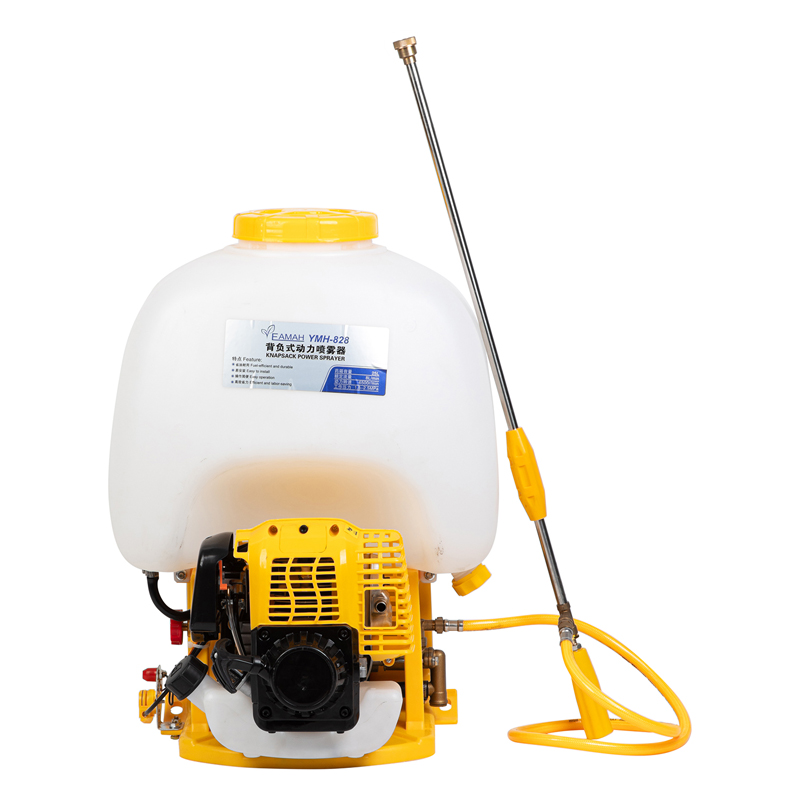
Medium-sized operations demand sustained pressure without the logistical nightmare of heavy tractor machinery. Motorized backpack units fill this crucial gap. Integrated power sources drive the internal pump, delivering a continuous, penetrating mist capable of coating dense foliage. For instance, a professional Knapsack Power Sprayer equipped with a robust TU26 2-stroke engine and a brass pump can generate up to 25 bar of pressure. With tank capacities ranging from 20 to 30 liters, these systems maximize field mobility while delivering commercial-grade atomization.
Carrying heavy liquid loads becomes an ergonomic hazard over long shifts. Wheeled systems provide the perfect engineering workaround. Mounted on rugged steel carts, these units boast massive tank capacities—often between 50 and 100 liters—coupled with extended high-pressure hoses. Commercial orchard managers frequently deploy a high-output Trolley Power Sprayer powered by a 168F 4-stroke engine. These heavy-duty systems push 30 to 50 bar of pressure, allowing workers to drench tall tree canopies without bearing any physical weight on their spines.
Engineered exclusively for massive flatland acreage, these units mount directly to utility tractors. They harness the vehicle power take-off shaft to drive high-volume pumps. Featuring wide, extendable booms with multiple nozzles, they cover multiple crop rows simultaneously. They require significant capital investment but offer unmatched automation for large-scale row crops.
Professional buyers must abandon guesswork and apply a strict technical framework. Evaluating the following parameters ensures a highly cost-effective procurement cycle.
Land dimensions and soil conditions strictly dictate equipment mobility. Imagine navigating a muddy, terraced hillside. A wheeled cart will instantly bog down or tip over. Uneven, densely planted terrains demand the agility of a wearable backpack unit. Conversely, flat, accessible orchards make trolley units highly advantageous, drastically reducing refill downtime and operator fatigue.
Plant structure determines your required kinetic energy. Mature fruit trees require high-pressure motorized pumps to propel droplets upward, ensuring they coat the undersides of high-canopy leaves. In contrast, low-growing vegetables like lettuce require gentle precision. Excessive pressure easily damages fragile leaves and causes liquid to bounce off the plant entirely. Low-pressure boom setups or carefully calibrated manual units excel in these delicate applications.
Selecting tank size requires balancing operational weight against refill frequency. Water weighs one kilogram per liter. A standard 20-liter backpack represents the safe ergonomic limit for a human operator over an eight-hour shift. If your agronomic protocol requires high-volume drenching, you must transition to a wheeled or vehicle-mounted system to prevent severe repetitive strain injuries among your workforce.
For buyers finalizing their equipment fleet, choosing between manual and motorized mechanics is the ultimate hurdle. Let us look at the engineering realities.
Upgrading to a motorized pump yields immediate, measurable efficiency gains. The primary engineering advantage is unregulated, consistent pressure. Manual pumping inherently causes pressure spikes and drops as the operator fatigues. This results in erratic droplet sizes and patchy coverage. Motorized pumps deliver a flat, continuous flow curve. This uniform atomization ensures droplets adhere perfectly to the target, slashing chemical runoff. Workers maintain focus on precise application rather than physical exertion.
Once you commit to a motorized platform, the power source must match your environment.
Modern battery units utilize advanced lithium-ion cells. They operate silently, generate zero localized emissions, and eliminate carburetor maintenance. They serve as the gold standard for commercial greenhouses and noise-restricted urban boundaries. On the other hand, gasoline engines utilizing reliable 2-stroke or 4-stroke technology generate vastly superior pressure outputs. They offer infinite run times as long as fuel is available, remaining the undisputed choice for rugged, off-grid agricultural zones.
True equipment longevity lies inside the housing. The quality of internal fluid dynamics dictates both maintenance schedules and daily chemical efficiency.
The pump is the mechanical heart of your equipment. Piston pumps generate immense pressure, making them ideal for liquid herbicides and systemic insecticides. However, their internal cylinder walls suffer rapid scoring if exposed to abrasive wettable powders. Diaphragm pumps solve this issue. They utilize a flexible internal membrane, keeping harsh chemicals isolated from moving metal parts. This friction-free design makes diaphragm pumps incredibly resilient against abrasive agricultural mixtures.
Nozzles dictate droplet micron size, spray angle, and flow velocity. Installing the wrong nozzle guarantees chemical waste and severe wind drift. Flat fan nozzles emit a precise, linear sheet of liquid, perfect for broad-spectrum herbicide application along flat soil beds. Hollow cone nozzles generate a swirling, turbulent mist that penetrates complex foliage to deliver insecticides effectively. High-quality brass adjustable nozzles give operators the flexibility to switch from a solid stream to a fine mist instantly.
A dangerous misconception in farming is that higher pressure always yields better results. In reality, excessive pressure fractures liquid into microscopic droplets that simply float away on the breeze. Effective weed control requires low pressure, typically between 1 and 2 bar. This creates heavy droplets that fall directly onto the target weed. Conversely, penetrating dense orchard canopies absolutely requires the brute force of a motorized pump sustaining 20 to 40 bar.
Separating disposable consumer tools from professional agricultural machinery requires inspecting material science and ergonomic engineering.
Agrochemicals are inherently corrosive. Premium tanks must be injection-molded from High-Density Polyethylene infused with heavy UV inhibitors. This prevents the plastic structural matrix from degrading under intense solar radiation. Internally, all seals and O-rings must utilize Viton or similar fluoroelastomers to prevent catastrophic chemical leaks. Lances and wands should feature stainless steel or thick brass construction to survive inevitable field impacts.
Operator comfort directly correlates with daily hectare coverage. Wearable units must feature thick, closed-cell foam shoulder straps. Load-bearing waist belts are critical to transfer fluid weight from the spine to the hips. For engine-driven models, manufacturers must install heavy-duty elastomer isolation mounts between the engine block and the frame to absorb high-frequency vibrations, protecting the operator's nervous system.
Cross-contaminating a tank with herbicide before applying delicate fertilizer will decimate a harvest. Equipment must facilitate rapid, thorough decontamination. Look for wide-mouth tank openings that prevent chemical splashing during mixing and allow easy access for internal scrubbing. Multi-stage inline filtration is equally critical to trap particulate debris before it scores the pump chamber or clogs the nozzle orifice.
For regional distributors and commercial farm cooperatives, scaling up equipment fleets requires strict supplier auditing to ensure long-term operational stability.
When importing machinery, demand rigorous documentation. Suppliers must provide ISO 9001 certifications, proving their assembly lines adhere to strict quality control tolerances. For combustion-engine models, CE marks and EPA compliance certificates are non-negotiable to clear customs and meet regional environmental mandates.
Even the most robust pump will eventually require fresh seals. A fleet of sprayers is entirely useless without immediate access to replacement components. Before executing a bulk purchase contract, verify that the manufacturer maintains a deep inventory of brass manifolds, nozzles, hoses, and carburetor rebuild kits. Rapid after-sales support is the only way to prevent catastrophic downtime during the peak spraying season.
Wholesale distributors building brand equity should partner with factories offering robust Original Equipment Manufacturer services. Top-tier suppliers can mold custom tank colors, emboss corporate logos directly into the polyethylene, and calibrate specific pump displacements to match the exact agronomic demands of your local climate.
Deploying the correct application technology actively reduces your seasonal chemical expenditures by eliminating runoff and drift. Before finalizing your procurement strategy, meticulously map your terrain and crop architecture to determine the exact pressure and mobility requirements. Scrutinizing pump mechanics and nozzle dynamics ensures your investment handles harsh wettable powders and corrosive liquids without premature failure.
Ultimately, prioritizing heavy-duty materials and ergonomic design guarantees your machinery survives the brutal realities of daily agricultural use. By mastering the engineering principles behind application equipment, you protect your capital investment, streamline field labor, and secure a highly profitable harvest. If you are ready to upgrade your fleet, explore professional-grade solutions from trusted manufacturers to find the exact specifications your operation demands.
For plots under one acre, a 16-liter to 20-liter battery-powered knapsack unit provides the optimal balance of efficiency and cost. These systems deliver consistent pressure for spot treatments and greenhouse applications without the maintenance overhead of a gasoline engine.
Calibration requires measuring your exact forward walking speed, the specific nozzle flow rate per minute, and the spray swath width. By cross-referencing these three metrics, you can calculate the exact volume of liquid applied per hectare, allowing you to adjust pressure or walking speed to meet chemical label requirements.
Herbicides require coarse droplets, typically between 300 and 500 microns, to minimize wind drift and ensure the chemical reaches the soil or broadleaf target. Insecticides and fungicides require fine droplets, usually between 100 and 200 microns, to create a swirling mist that coats the underside of dense foliage.
Agronomists strictly advise against this practice. Herbicide residue embeds itself into plastic walls and hoses. Even after triple-rinsing, trace amounts can easily leach into fertilizer mixtures and severely stunt or kill sensitive cash crops. Always maintain dedicated, color-coded equipment for herbicides.
Always flush the entire system with clean, fresh water immediately after the spraying shift ends. Leaving harsh chemicals inside the pump chamber overnight causes elastomers to swell, crack, and degrade. Additionally, regularly inspect and clean all inline filters to prevent abrasive grit from tearing the internal piston seals.


