
Views: 0 Author: Site Editor Publish Time: 2026-07-16 Origin: Site


The transition from manual hand-pump sprayers to battery-powered systems represents a significant jump in upfront cost, leaving buyers questioning the actual return on investment (ROI). Many property owners wonder if ditching the traditional pump lever truly pays off over time. You face a critical choice balancing initial expense against long-term operational efficiency.
Frame the decision not just as a matter of convenience, but as an evaluation of application accuracy, physical fatigue, and time management for large-scale or frequent spraying tasks. Applying chemicals unevenly harms turf health and wastes expensive products. You must weigh the upfront premium against substantial daily operational gains. Your physical stamina directly impacts the quality of your lawn care results.
Establish that the "worth" depends entirely on usage volume, property size, and the specific form factor chosen (from standard backpacks to a high-capacity trolley power sprayer). We will break down exactly how pressure consistency, ergonomic relief, and maintenance realities dictate your best path forward. You will learn exactly how to align your equipment choice to your specific land management needs.
Application Accuracy: Battery power provides consistent PSI, preventing the costly over-application of herbicides and fertilizers common with manual pumps.
Fatigue Reduction: Eliminating manual pumping saves physical exertion, though battery units carry a heavier dry weight.
Scalability: For properties over half an acre or commercial use, upgrading to a wheeled trolley power sprayer drastically reduces back strain and refill frequency.
Maintenance Trade-offs: The convenience of battery power introduces new failure points (batteries, electronic pumps) requiring strict winterization and cleaning protocols.
Manual pumps create a wave-like spray pattern. You pump the lever to reach high PSI, but pressure drops quickly as fluid exits the wand. You get heavy application initially and a weak drizzle moments later. This erratic pressure arc leads to uneven chemical coverage. Weeds survive in under-treated patches, while over-treated grass suffers chemical burns. You waste expensive chemical mixtures trying to compensate for these inconsistent spray patterns.
Stopping to pump every 10 to 15 seconds eats up precious daylight. You disrupt your walking pace constantly. This hidden time cost multiplies when you manage large areas. Calculate the minutes lost just standing and pressurizing the tank. A typical half-acre yard application easily stretches an extra 20 minutes due to manual pumping pauses alone. Time inefficiencies pile up over an entire spraying season.
Address the severe physical toll next. Carrying four gallons of liquid weighs roughly 33 pounds. You must support this weight while continuously using one arm to maintain tank pressure. This awkward, one-sided movement exhausts your shoulder and lower back muscles rapidly. Operator fatigue reduces your overall walking speed and leads to sloppy wand control. Your body absorbs significant strain before the job is even half finished.
Continuous spraying slashes job times by 30 to 50 percent. You walk at a steady, uninterrupted pace. Eliminating the manual pumping cycle keeps the wand actively spraying at all times. Professionals often regain hours of lost labor each week. Homeowners reclaim their weekend afternoons significantly faster. Time savings alone often justify the battery upgrade during the first active season.
A steady flow rate allows for highly precise walking speeds and calibration. Spraying exactly 0.5 GPM at 40 PSI ensures optimal coverage every single pass. You apply expensive herbicides and pesticides accurately. Preventing chemical waste saves considerable money over several months. You stop pouring excess product into the soil unnecessarily. Precision application protects your wallet and the surrounding environment simultaneously.
Physical health offers tangible financial returns. Ergonomic benefits protect commercial operators and users facing mobility limitations from chronic joint pain. Reducing back strain prevents costly medical bills and lost working days. You maintain higher energy levels for other demanding landscaping tasks. Ergonomics should factor heavily into your financial calculations.
Define the baseline break-even threshold clearly. If you spray more than twice a month or manage over 10,000 square feet, time and material savings justify the premium. Upgrading makes clear financial sense past this specific usage point.
Usage Volume | Manual Sprayer Efficiency | Battery Sprayer Efficiency | Chemical Waste Risk |
|---|---|---|---|
Spot spraying (< 2,000 sq ft) | Adequate | Overkill | Low |
Medium Lawns (2,000 - 10,000 sq ft) | Moderate effort | 30% faster application | Moderate |
Large Lawns / Commercial (> 10,000 sq ft) | High fatigue / Slow | 50% faster application | High (if using manual) |
Battery backpack sprayers represent the standard consumer upgrade path. They work best for rough terrain, smaller enclosed yards, and highly targeted spot spraying. You strap them on to navigate steep hills and tight garden beds easily. They keep your hands free to manipulate foliage or move obstacles. However, they carry a high combined weight. A heavy lithium battery, the pump module, and four gallons of water easily exceed 40 pounds directly on your spine. This load requires strong shoulders and good balance.
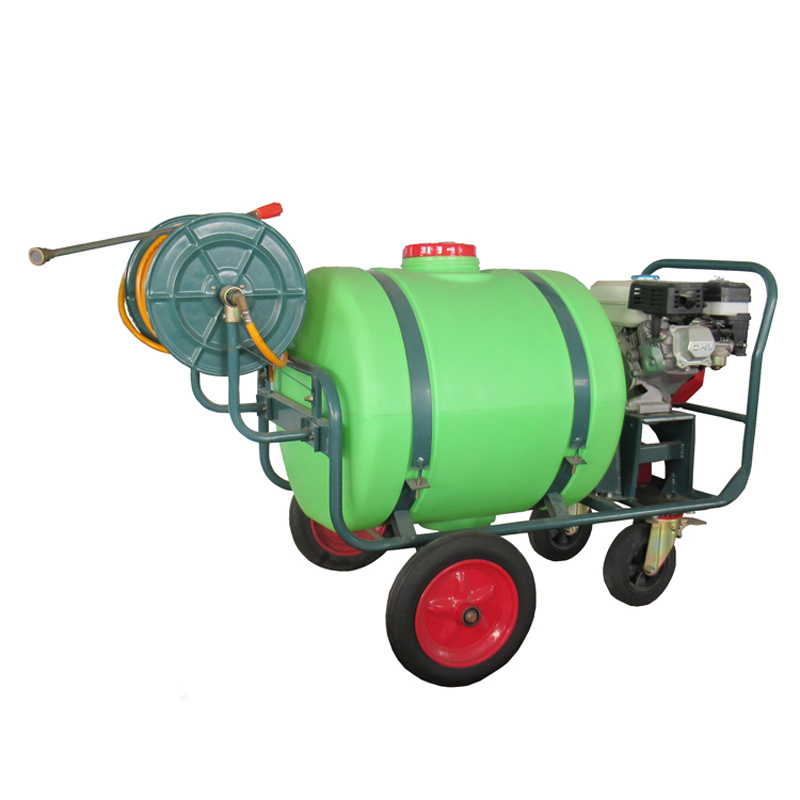
Rolling units serve as the ultimate high-capacity solution for serious property managers. They excel across flat properties, large acreage, driveways, and commercial applications. You remove heavy liquid weight from the operator entirely. They offer massive tank capacities ranging from 6 to 12 gallons or more. You drastically reduce frustrating refill trips to the water spigot.
Scalability becomes effortless when you deploy a Trolley Power Sprayer for your property management. These systems typically include much longer hoses and highly adjustable wands. You can leave the cart parked safely on a flat path while treating surrounding garden zones. Your back remains entirely free from strain. You cover massive square footage in a fraction of the time.
Choosing the correct internal components determines your success. You must evaluate several technical features before committing to a purchase.
We highly recommend diaphragm pumps for handling wettable powders and harsh agricultural chemicals. Diaphragm mechanisms pulse fluid safely through the system. Gear pumps rely on interlocking teeth. Abrasive powders grind down gear pumps quickly, destroying internal seals. Diaphragm models resist internal wear and provide vastly superior longevity.
Check the required battery ecosystem compatibility carefully. Proprietary batteries limit your flexibility and cost more to replace. Advise buyers to check if the sprayer integrates into existing 18V or 20V ecosystems from major power tool brands. Using your existing garage tool batteries saves significant upfront money. You ensure constant power availability during long jobs.
Adjustable PSI controls remain absolutely essential for safe operation. A variable pressure dial allows you to adapt to different tasks instantly. You need low 20 PSI pressure for delicate herbicides to prevent dangerous chemical drift onto nearby flowers. Conversely, you might require 100 PSI to reach high tree canopies effectively. Fixed-pressure units lack this crucial versatility.
Examine the overall tank architecture and filtration systems closely. Look for wide-mouth lids to prevent hazardous chemical spills during mixing. Drain plugs simplify the mandatory cleaning process immensely. Multi-stage filters prevent pump clogging entirely. Ensure your chosen unit features both a deep tank basket and a secondary inline wand filter.
Measure your total sprayable square footage before shopping.
Inventory your existing power tool batteries to check ecosystem compatibility.
Verify the pump style (diaphragm) if you plan to use powdered concentrates.
Test the wand ergonomics and hose length in-store if possible.
Acknowledge the dry weight penalty immediately. Battery sprayers inherently weigh more when completely empty compared to manual counterparts. You must account for heavy electric motors and lithium battery packs. A standard manual tank might weigh five pounds dry, while a battery unit can easily weigh fifteen pounds before adding water. You must lift this heavier unit onto a truck bed or workbench frequently.
Be fully transparent about component lifespans. Pump seals degrade naturally, and battery cells lose charging capacity over three to five years. You face inevitable replacement costs down the line. Electronic sensors and wiring harnesses occasionally fail due to moisture exposure. These high-tech units demand careful storage away from extreme heat and humidity.
Emphasize strict winterization needs heavily. Failing to flush the pump system before freezing temperatures arrive destroys the equipment. You must run specialized pump saver fluid or RV antifreeze through the lines every autumn. Trapped water expands inside the pump mechanism during freezes. This expansion results in cracked plastic housings and ruined electronic pumps. Ignorance here guarantees a dead unit next spring.
Contrast the repairability of both systems honestly. Fixing manual sprayers costs mere pennies and requires basic tools. You easily swap out a $5 manual O-ring in five minutes. Conversely, replacing an electronic pump module often exceeds $40. Electrical repairs require specific diagnostic skills and specialized replacement modules. You trade simplicity for daily convenience.
Leaving corrosive bleach or vinegar sitting in the tank overnight.
Storing lithium batteries in unheated sheds during freezing winter months.
Failing to clean the inline wand filter after using wettable powders.
Spraying at maximum PSI for delicate weed control, causing chemical drift.
Stick to a manual pump if your usage remains extremely minimal. Keep manual units if you spray only once or twice a season. They suit small urban lots perfectly. Use manual tanks exclusively for highly corrosive chemicals like bleach. You likely prefer not leaving harsh oxidizing agents inside sensitive electronic pump systems. Manual sprayers offer cheap reliability for rare, isolated tasks.
Buy a battery backpack model if you manage medium-to-large residential properties. Choose this path if your land features uneven terrain or steep hills. Wheels cannot easily travel up rocky embankments or through dense woodland trails. A backpack provides unmatched mobility. You gain the steady pressure of electric power while maintaining agile footwork across difficult landscapes.
Invest heavily in wheeled cart models if you prioritize ergonomics above all else. They conquer extensive flat lawns, large orchards, and long gravel driveways efficiently. Operating a commercial lawn care business demands maximum efficiency without risking operator fatigue. Rolling your chemical supply eliminates spinal compression entirely. You work faster, safer, and much smarter.
Final Verdict: Summarize that a battery-powered sprayer is definitively "worth it" for users prioritizing application precision and reduced labor, provided they commit to proper post-use maintenance.
Next Action: Prompt the reader to assess their terrain and physical limits to decide between a backpack or a wheeled trolley model, and to check their current power tool battery compatibility.
A: Most modern 18V or 20V battery systems provide enough power to spray 20 to 40 gallons continuously per charge. Your actual runtime depends heavily on the battery's amp-hour (Ah) rating and your chosen PSI setting. Higher pressure settings drain the battery faster. Carrying a spare charged battery guarantees uninterrupted commercial application.
A: You can use wettable powders only if the unit features a high-quality diaphragm pump. Gear pumps break down rapidly when exposed to abrasive powders. You must also agitate the tank frequently to prevent settling. Always perform an aggressive freshwater flush immediately after finishing your application to prevent severe internal clogs.
A: With proper freshwater flushing after every use and strict winterization, a quality electronic pump easily lasts three to five seasons or more. However, poor maintenance kills these units rapidly. Leaving harsh chemicals in the lines or allowing water to freeze inside the housing destroys the pump manifold in just one season.
A: Maneuverability depends entirely on the wheel design. Units featuring large pneumatic tires or oversized solid wheels roll easily across uneven turf and bumpy gravel. Small, hard plastic wheels struggle on soft grass and easily get stuck in mud. Always select models prioritizing tall, rugged wheelbases for outdoor terrain.


