
Views: 0 Author: Site Editor Publish Time: 2026-09-06 Origin: Site


Effective pest control, weed management, and crop fertilization are the lifeblood of a successful harvest. Applying these essential chemicals efficiently requires selecting the exact right equipment for your specific field conditions. A mismatch between your sprayer and your crop architecture wastes expensive chemicals and drains your labor budget.
Looking at the current trajectory of global agriculture, we see a massive shift in equipment strategies. Rural labor is becoming scarce and expensive across the board. Meanwhile, climate volatility means farmers have much shorter, unpredictable weather windows to apply chemicals safely. This reality forces a move from traditional manual labor to mechanized efficiency. The choice between a manual backpack and a motorized sprayer is no longer just a matter of operator comfort. It is a critical business decision that directly impacts yield protection and operational survival.
In this engineering guide, we break down the mechanics behind these two systems. We will look past the marketing fluff to explore their actual pump mechanisms, practical field applications, and true cost of ownership. By the end, you will know exactly which spraying system delivers the best Return on Investment for your specific acreage.
Think of a knapsack sprayer as the standard infantry tool of crop protection. Worn on the operator's back with padded straps, these portable units are engineered from high-density polyethylene to resist harsh UV rays and corrosive agricultural chemicals. They typically hold a liquid volume ranging from 12 to 20 liters. Their primary job is to deliver liquid fertilizers, delicate biological agents, or harsh herbicides directly to the target zone.
Within the agricultural sector, backpack units are defined by their internal pump designs and power sources. Understanding these differences is key to preventing premature equipment failure.
Portability is the greatest asset of a manual backpack. Because the operator carries the entire system, it goes wherever boots can walk. This makes it indispensable for steep terraces, deeply rutted mud, or tight high-tunnel greenhouses where wheeled carts get hopelessly stuck.
They are also incredibly cheap to maintain. Mechanical simplicity means that when a manual sprayer fails, it is usually just a blown O-ring or a clogged nozzle tip. You can fix it in the field in five minutes with spare parts that cost pennies. Furthermore, their low-pressure output produces large, heavy droplets. This is a massive advantage for precision weed control, as heavy droplets fall straight down without drifting onto your valuable cash crops.
The limitations become obvious the moment you scale up. A 20-liter tank empties fast. If your application rate is 100 liters per acre, your operator must stop, walk back to the mixing station, and refill five times just to finish one acre. That downtime destroys labor efficiency.
Pressure is another major failure point. Manual pumps max out around 60 PSI. That is simply not enough force to push a chemical spray up into the canopy of a mature apple tree or blast through the dense, overlapping leaves of mature soybeans. Finally, carrying 20 kilograms of sloshing liquid across muddy terrain for eight hours causes severe operator fatigue, slowing down application speeds as the day drags on.
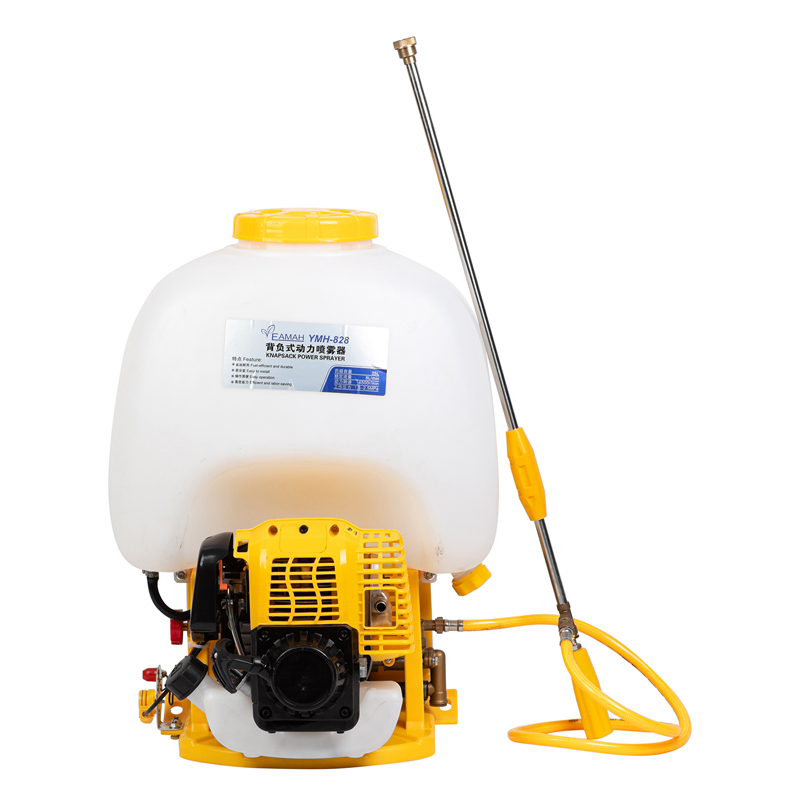
When manual pumping fails to keep up with the scale of the farm, power sprayers take over. These are heavy-duty, motorized machines engineered to project massive volumes of liquid at exceptionally high pressures. Instead of relying on a human arm, these systems are driven by robust 2-stroke or 4-stroke gasoline engines, or high-torque electric motors. They are designed for one purpose: maximizing coverage speed and chemical penetration across vast landscapes.
The motorized sprayer family is divided by how the equipment is transported across the field.
The agronomic magic of a motorized pump lies in its pressure output. Engine-driven pumps easily exceed 300 PSI. This immense force shatters the chemical fluid into microscopic droplets. Smaller droplets mean exponentially better surface coverage on the leaves. The high velocity also creates air turbulence, physically flipping the crop leaves to coat the undersides where spider mites and aphids breed.
Labor reduction is dramatic. By utilizing large external tanks and high-flow pumps, you eliminate constant refilling. A single worker equipped with reliable portable power sprayers can cover in four hours what would take a three-man crew all day to accomplish with manual backpacks.
High performance comes with high overhead. Motorized equipment requires a serious upfront capital investment. You also take on the burden of engine maintenance. Unlike a simple manual pump, a fouled spark plug, a clogged carburetor jet, or stale gasoline can halt your entire spraying operation. You must also winterize the brass pump fittings carefully, or trapped water will freeze and crack the expensive pump housing.
Maneuverability also suffers. Dragging 100 feet of heavy, pressurized hose through delicate vining crops requires careful footwork to avoid snapping plants. In extremely steep or rocky terrain, wheeled carts are completely useless.
To make a smart purchasing decision, you must look at the raw engineering metrics. Below is a direct comparison of the operational capabilities of both systems.
| Operational Feature | Manual Knapsack Sprayer | Motorized Power Sprayer |
|---|---|---|
| Operating Pressure | 15 to 60 PSI | 300 to 500+ PSI |
| Droplet Size & Drift | Large droplets. Low drift risk. | Fine atomized mist. High drift risk in wind. |
| Tank Capacity | 12 to 20 Liters | 30 Liters up to 200+ Liters |
| Canopy Penetration | Poor. Surface coating only. | Excellent. High velocity flips leaves. |
| Maintenance Complexity | Low. Simple O-ring replacements. | High. Requires engine and pump servicing. |
Do not buy equipment based on what looks impressive. Buy based on the specific architecture of your crops and the realities of your workforce. Here is how to match the tool to the field.
If you run a market garden or a hobby farm under two acres, manual application remains the most cost-effective route. The time it takes to mix 100 liters of chemical, prime a gas engine, and clean a 100-foot hose afterward is simply not worth it for small plots.
Indoor environments demand manual or battery power. Running a 2-stroke engine inside a poorly ventilated greenhouse creates a lethal carbon monoxide hazard for workers and coats delicate seedlings in toxic exhaust. Finally, if you are spot-spraying non-selective herbicides like glyphosate near cash crops, you need the low-pressure, heavy droplets of a manual pump to prevent the wind from blowing the poison onto your harvest.
The moment your farm scales past five acres, manual spraying becomes a mathematical liability. You are paying too much in hourly wages for workers to walk back and forth refilling tiny tanks. Upgrading to knapsack power sprayers or wheeled units immediately solves this labor bottleneck.
Crop architecture also forces the upgrade. If you manage an orchard, a manual pump physically cannot defeat gravity. You need 300 PSI to push fungicide into the top branches of a mature citrus tree. The same applies to dense row crops like cotton or mature tomatoes. If the spray does not penetrate the outer canopy to reach the inner stems, your pest control efforts will fail. Motorized pressure guarantees that penetration.
Agricultural professionals know that the sticker price of a machine is only a fraction of its true cost. You must calculate the Total Cost of Ownership against the Return on Investment.
Manual backpack units preserve working capital. For a first-year farmer, this low barrier to entry is crucial. However, labor is the most expensive recurring cost in farming. Consider a 10-acre plot. Using manual units, a crew of three might take 12 exhausting hours to spray the field. At standard agricultural wages, that single application costs a fortune in labor.
By transitioning to a high-capacity motorized system, one single operator can spray those same 10 acres in just four hours. The savings in hourly wages from just five spraying sessions will completely pay off the higher purchase price of the engine-driven sprayer.
Furthermore, chemicals are incredibly expensive. Low-pressure manual spraying often results in runoff, where excess liquid drips off the leaves and into the dirt. The superior atomization of a high-pressure pump ensures a fine, even coat that sticks to the plant tissue. You achieve higher kill rates on pests while actually using less total chemical volume per acre. That is pure profit added back to your bottom line.
In the end, neither sprayer is universally superior. A manual backpack is an indispensable tool for precision weed control, greenhouse work, and small plots. But for commercial acreage, tall orchards, and operations bleeding money on labor costs, an engine-driven pump is an absolute necessity.
Stop losing money on inefficient application methods and wasted chemicals. Evaluate your canopy density, calculate your labor costs, and invest in the machinery that matches your scale. To ensure you get durable, commercial-grade performance, explore a full lineup of professional agricultural sprayers. Equip your farm with the right technology today, and protect your yields for the seasons to come.
Yes. Manufacturers build motorized knapsack sprayers specifically for this purpose. They mount a lightweight 2-stroke engine and a high-pressure pump onto a wearable frame. This gives you the mobility of a backpack with the atomization power of an engine. Just be aware they are significantly heavier than manual units and require good ergonomic straps to prevent back strain.
A motorized power sprayer is the only viable option for mature orchards. Overcoming gravity to reach the upper canopy requires a minimum of 200 to 300 PSI, which manual pumps cannot generate. Engine-driven systems paired with a high-pressure spray gun allow you to thoroughly coat the highest branches where pests typically hide.
They are excellent for eliminating the physical fatigue of hand-pumping and operate silently without exhaust fumes, making them perfect for greenhouses. However, current 12V or 24V electric backpacks cannot match the sheer sustained pressure, flow volume, and vertical reach generated by a gasoline combustion engine. They fill the gap between manual and gas, but do not replace gas for heavy-duty canopy penetration.
A piston pump uses a cylindrical plunger moving up and down to create pressure, which is great for high PSI but easily damaged by abrasive chemicals. A diaphragm pump uses a flexible rubber disc that pulses to move fluid. Because there are no sliding parts against a cylinder wall, diaphragm pumps are highly durable and ideal for spraying abrasive wettable powders and heavy liquid fertilizers.
Calibration requires measuring three variables: your walking speed, the nozzle flow rate, and the spray width. First, measure how many seconds it takes to walk a set distance in the field. Next, spray water into a measuring jug for that exact amount of time to find the volume per nozzle. Multiply that by the number of nozzles and divide by the coverage area to determine your true application rate per acre. Adjust your pressure or walking speed until it matches the chemical manufacturer's label requirements.
Basic maintenance must happen after every single use. You must flush the tank, pump, and hoses with clean water to prevent chemical crystallization, which destroys seals and clogs nozzles. For motorized systems, check the engine oil and clean the air filter monthly. Before winter, you must run an RV antifreeze solution through the pump to prevent residual water from freezing and cracking the brass pump housing.
It requires extreme caution. High-pressure systems create a very fine atomized mist designed to float into crop canopies. If you spray non-selective herbicides like glyphosate at high pressure, even a tiny breeze will cause chemical drift, carrying the weed-killer directly onto your valuable cash crops. For herbicides, a low-pressure manual sprayer with a drift-guard nozzle is vastly safer.


