
Views: 0 Author: Site Editor Publish Time: 2026-09-08 Origin: Site


Are stubborn weeds creeping across your gravel driveway? Perhaps a sudden aphid infestation is threatening your vegetable patch. Having the right equipment dictates whether the job takes a grueling afternoon or a highly efficient hour. Choosing between a highly mobile backpack unit and a heavy-duty wheeled cart is rarely a simple coin toss. Each system brings distinct operational advantages to the field. Your final decision will depend heavily on the topographical challenges and total acreage of your specific plot.
In this engineering-focused guide, we will break down the fluid mechanics, structural advantages, and ideal field applications for both systems. By examining the practical realities of agricultural work, you will learn exactly which sprayer aligns with your daily agronomic demands and maintenance budget.
A knapsack sprayer is a specialized horticultural tool engineered to be worn squarely on the operator's back. It utilizes a padded harness system remarkably similar to a professional hiking backpack. Manufacturers typically construct the main tank from high-density polyethylene to withstand caustic agricultural chemicals and harsh UV degradation. These sprayers feature a tank capacity generally ranging between 16 and 20 liters. This specific volume is carefully calculated by engineers. It balances adequate fluid coverage with a manageable weight load for the human spine.
The core mechanism revolves around an internal pump block. This is usually either a piston or a diaphragm variant. The pump pressurizes the liquid, forcing it through a flexible reinforced hose and out of a wand equipped with a precision brass or plastic nozzle. Depending on your operational scale, a knapsack power sprayer can be driven manually via a repetitive hand lever, electrically through a rechargeable 12V lithium-ion battery, or mechanically via a compact 2-stroke gasoline engine.
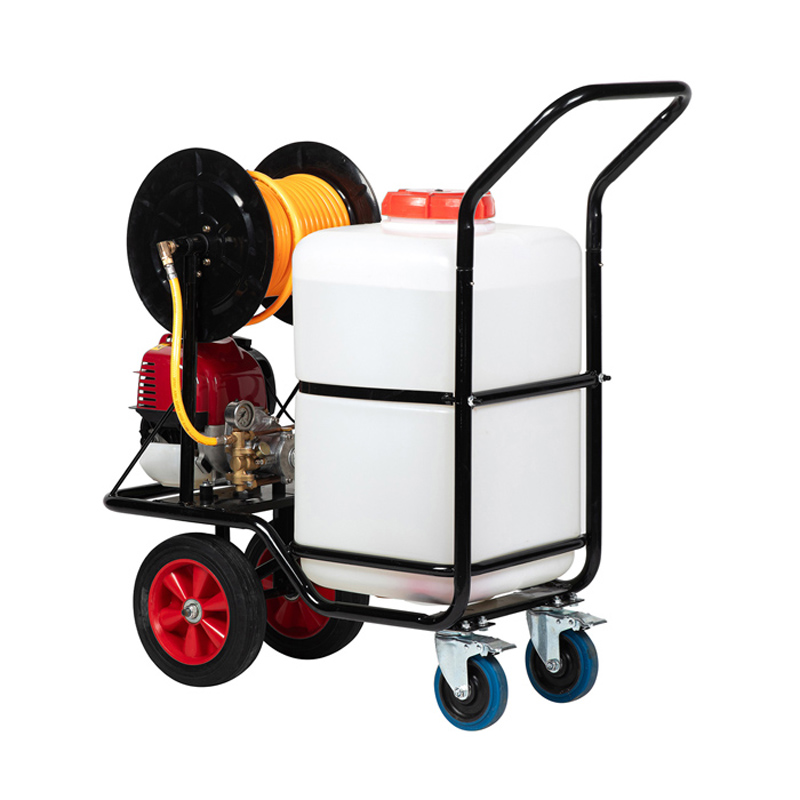
In stark contrast to wearable units, a trolley sprayer is a high-capacity liquid application system mounted securely on a wheeled steel chassis. Engineers purposely designed these machines to relieve field workers of the grueling physical burden of carrying heavy chemical solutions. Consequently, their tank sizes are substantially larger. You will commonly see models like a 60L trolley power sprayer, while commercial-grade variants can easily exceed 100 liters.
The architecture consists of a heavy-duty tubular steel frame, large pneumatic tires for navigating packed dirt, a high-volume polymer tank, and a high-performance pump system. Because the operator does not bear the fluid weight, manufacturers equip these carts with robust power sources. They are predominantly powered by commercial 4-stroke gasoline engines or high-capacity lead-acid batteries capable of generating immense output pressure.
When evaluating these two fluid application systems, it is vital to look at empirical data and operational mechanics rather than subjective preference. Recent market data reveals a distinct shift in commercial farming equipment preferences. As modern agricultural practices lean heavily toward ergonomic safety and labor efficiency, facility managers are actively phasing out heavy wearable gear in favor of high-capacity wheeled units. Strict occupational health guidelines now push for reduced spinal loading on workers.
Furthermore, the wearable market is not shrinking but is pivoting sharply toward high-efficiency lithium-ion models. This technological leap renders traditional manual hand-pumps increasingly obsolete for professional outfits. This evolution in agricultural sprayers highlights a growing industry demand for machinery that balances raw output with operator well-being.
Understanding this landscape helps frame how these two systems compare across vital agronomic metrics.
| Engineering Metric | Knapsack Sprayer | Trolley Power Sprayer |
|---|---|---|
| Average Tank Capacity | 16 to 20 Liters | 60 to over 100 Liters |
| Operator Physical Strain | High spinal load | Low rolling load |
| Ideal Topography | Slopes, rocky ground, tight spaces | Flat turf, paved aisles, mild inclines |
| Refill Frequency | High interruption rate | Extended continuous operation |
Selecting the right chassis is only half the battle. Determining the internal propulsion method is equally critical to fluid delivery success. Both sprayer formats offer different power plants tailored to specific environments.
Manual Pump for Knapsack Units: Relying entirely on human kinetic energy, the operator pumps a lever with one hand to build pressure in the air chamber while directing the wand with the other. This mechanical setup is incredibly reliable and requires virtually zero maintenance. It remains ideal for budget-conscious buyers without access to field electricity or fuel.
Battery-Powered Systems: Lithium-ion technology has revolutionized agricultural liquid application. Utilizing a quiet electric motor to drive a diaphragm pump, these units are eco-friendly and produce zero exhaust emissions. Specifically, they are the mandatory choice for enclosed greenhouses or noise-sensitive residential neighborhoods. They provide a beautifully consistent spray pattern until the battery voltage drops.
Motorized Engine Systems: Utilizing internal combustion engines, these sprayers power heavy-duty brass plunger pumps. They offer unmatched pressure and volume output. If you are managing a remote commercial orchard where recharging battery packs is logistically impossible, a reliable gas-powered motor is your most viable field option.
To maximize the return on your equipment investment, the machine must align seamlessly with your daily real-world tasks. Different environments highlight the distinct engineering strengths of each system.
The defining characteristic of a backpack unit is precision agility. It is an indispensable tool for targeted chemical applications. Professional turf managers rely on them for spot-spraying weeds in complex garden beds to avoid scorching non-target ornamental plants. Furthermore, agricultural plots located on steep inclines present severe navigational hazards. A wearable tank allows the operator to maintain their center of gravity while climbing hillside vineyards.
In contrast, a wheeled cart is engineered for brute volume and endurance. Modern commercial greenhouses feature flat, heavily compacted dirt aisles. A battery-powered trolley provides the high-volume output necessary to treat thousands of seedlings rapidly while eliminating hazardous exhaust fumes indoors. Additionally, treating mature citrus trees requires significant vertical reach. The high-pressure motorized pumps atomize the liquid into fine droplets, propelling them high into dense canopies to coat the undersides of leaves where pests congregate.
Over-investing in a massive machine for a small backyard leads to wasted capital. Under-investing in a manual backpack for a sprawling orchard leads to severe operator fatigue. When deciding if you need a trolley power sprayer or a backpack model, follow this systematic evaluation matrix.
First, calculate the total square footage that requires regular treatment. As a general benchmark, if you are managing under one acre, a backpack unit is highly efficient. If your operations exceed two acres, the labor hours lost to refilling a 16-liter tank easily justifies the financial upgrade to a high-capacity trolley.
Next, objectively evaluate your terrain. Walk your property and assess the ground conditions. If the land features deep irrigation ditches, rocky outcroppings, or thick mud during the wet season, a wheeled cart will quickly become a frustrating anchor. In these rugged environments, you must choose a wearable unit. If you have flat pastures or well-maintained orchard lanes, a trolley is mathematically optimal.
Finally, consider the operator's physical capabilities. Carrying 20 kilograms on the back requires significant core strength. If the primary operator suffers from chronic back pain, or if the spraying tasks last for over four hours a day, transferring that weight to a wheeled chassis is a necessary investment in occupational health.
Agricultural equipment operates in highly corrosive environments. Liquid fertilizers and pesticides contain caustic compounds that will rapidly degrade plastic tanks, eat away at rubber O-rings, and destroy metal pump components if neglected. Proper maintenance is strictly non-negotiable from an engineering standpoint.
Imagine leaving a wettable powder suspension in the tank overnight. By morning, it has settled into a concrete-like sludge at the bottom of the pump chamber. You must perform a triple-rinse procedure immediately after every use. Drain the tank, fill it with clean water, agitate thoroughly, and spray the clean water through the hoses to flush the internal lines. Leave the lid off to air-dry, preventing aggressive mildew accumulation.
Airborne drift and chemical splash-back are constant risks regardless of the machine's form factor. Operators must wear appropriate Personal Protective Equipment at all times. This includes chemical-resistant nitrile gloves, unvented safety goggles, long sleeves, and a highly rated particulate respirator to prevent the inhalation of toxic aerosolized droplets.
Ultimately, the debate between these two agricultural staples does not yield a single universal winner. It is entirely about matching the tool's fluid dynamics and structural engineering to your specific environmental hurdles. A knapsack sprayer remains the undisputed choice for agility, steep terrain, and budget-conscious precision work. In contrast, a trolley power sprayer is the ultimate heavy-duty solution for flat, expansive acreage where high liquid capacity and operator stamina are paramount. Evaluate your land size, respect your physical limits, and select the machinery that transforms a grueling chore into an efficient process.
If you are ready to upgrade your field operations, explore our complete lineup of professional agricultural spraying equipment. From precision backpacks to heavy-duty wheeled carts, finding the exact match for your terrain and workload is the first step toward a more productive harvest.
Yes, both machines are engineered to handle standard liquid fertilizers, herbicides, fungicides, and pesticides. However, you must always verify that the specific internal pump seals, such as Viton O-rings, are compatible with highly corrosive or solvent-based chemicals to prevent internal degradation and pressure leaks.
A motorized trolley power sprayer is generally far superior for mature orchards. The robust engine generates the higher pressure required to push the chemical mist deep into tall tree canopies. Furthermore, the large 60 to 100-liter tank significantly reduces the number of trips needed to refill at the mixing station.
Depending on the pump specifications and the nozzle type equipped, a commercial motorized trolley sprayer can project a vertical fluid stream between 8 to 12 meters. This makes them exceptionally well-suited for high-canopy fruit trees and washing down tall agricultural structures.
Pressure loss is almost always caused by debris clogging the intake filter or degraded internal seals. To maintain optimal working pressure, routinely clean the inline mesh filters. Additionally, flush the pump with clean water after every use to prevent chemical crystallization on the piston or diaphragm valves.
Most commercial-grade 12V lithium-ion battery sprayers will operate continuously for 4 to 6 hours on a full charge. This duration is typically sufficient to empty and apply 15 to 20 full tanks of liquid, easily covering a standard workday for most field operators.


