
Views: 0 Author: Site Editor Publish Time: 2026-08-01 Origin: Site


Scaling liquid application operations demands a fundamental shift in equipment. Businesses eventually outgrow manual pump sprayers. They need motorized solutions to maintain field productivity. This operational transition introduces power sprayers to your daily workflow. Manufacturers design these machines specifically for distributing chemicals, agricultural formulas, and sanitization liquids. They operate very differently from traditional high-pressure water cleaning tools.
Choosing the wrong equipment creates severe operational bottlenecks. You must evaluate tank capacity, flow rates, and mobility carefully. Aligning these factors ensures you meet specific job demands. Heavy liquid payloads require specialized transport solutions to remain safe. Wheeled formats often bridge the gap between portable packs and stationary skid units.
In this guide, you will learn exactly what these sprayers handle best. We will explore primary use cases across different demanding industries. You will discover how payload weight dictates critical mobility choices. Finally, we provide a clear framework for selecting the right pump and power source.
Distinct from Pressure Washers: Power sprayers prioritize volume and consistent liquid application (fertilizers, pesticides, disinfectants) over destructive high-pressure surface cleaning.
Scalability Through Mobility: Transitioning to a trolley power sprayer is the standard operational upgrade when payload weight (tank size) exceeds safe manual carrying limits.
Core Buying Criteria: Purchasing decisions should hinge on Flow Rate (GPM), Pump Durability (chemical resistance), and Power Source (Gas vs. Electric/Battery), rather than just raw PSI.
Risk Mitigation: Proper nozzle selection, chemical dilution management, and pump winterization are mandatory to protect the equipment investment.
Many operators confuse power sprayers and pressure washers. This misunderstanding leads to costly equipment damage and poor application results. You must understand the core engineering differences before deploying either machine. They serve entirely distinct operational purposes.
Power sprayers specialize in controlled liquid distribution. They operate at low-to-medium pressure levels. Instead of extreme force, they prioritize high volume output. The internal components feature specific chemical-resistant materials. Manufacturers commonly use Viton® or Kalrez® seals. These specialized elastomers withstand caustic fertilizers and herbicides. Standard rubber seals degrade quickly when exposed to such harsh agricultural chemicals. The pump mechanism atomizes the liquid into a precise droplet size. This ensures an even, uniform coating over broad areas.
Pressure washers rely entirely on high PSI ratings. They generate aggressive mechanical abrasion. Their primary goal is removing dirt, peeling paint, or scouring concrete. They use clean water almost exclusively. Some models allow downstream chemical injection. However, the internal pump seals rarely survive prolonged exposure to undiluted caustic agents. High pressure also atomizes chemicals too aggressively. This creates hazardous drift and uneven surface application.
Selecting between these tools requires a clear view of your ultimate goal. We developed the following matrix to simplify your procurement decision.
Operational Goal | Recommended Equipment | Key Performance Metric |
|---|---|---|
Distributing herbicides and pesticides | Power Sprayer | Gallons Per Minute (GPM) & Seal Material |
Stripping paint from siding | Pressure Washer | Pounds Per Square Inch (PSI) |
Applying concrete sealants | Power Sprayer | Consistent flow control |
Removing industrial grease from floors | Pressure Washer | PSI & Hot water capability |
Motorized sprayers deliver immense value across several industries. They replace tedious manual labor. They also guarantee a highly consistent application rate. Let us examine the most common professional use cases.
Farming and large-scale landscaping rely heavily on motorized spraying. Ground crews use them for broadleaf weed control across vast turf areas. Orchard managers depend on them for foliar fertilization. The equipment allows for rapid, large-scale pest mitigation. In these scenarios, coverage speed becomes a critical success factor. Operators also need strict control over droplet size. Large droplets prevent wind drift when applying volatile herbicides. Fine misting ensures total leaf coverage when applying delicate fungicides.
The sanitization industry adopted these tools rapidly over the last decade. Facility managers use them to apply disinfectants in massive warehouses. Agricultural cooperatives deploy them to sterilize livestock enclosures. Relying on manual pump sprayers in a 50,000-square-foot facility incurs prohibitive labor costs. Motorized units allow a single operator to sanitize entire commercial estates quickly. The consistent pressure guarantees wet-contact times remain uniform across all surfaces.
Construction sites utilize specialized sprayers for chemical coatings. Workers apply concrete curing compounds to freshly poured slabs. They spray form release agents onto wooden concrete molds. Industrial contractors also use them for large-scale waterproofing sealants. These viscous liquids destroy standard water pumps. Specialized diaphragm pumps handle these heavier chemicals effortlessly.
Every use case mentioned above shares a common set of desired outcomes. You deploy this equipment to solve specific operational friction points.
Operator Fatigue Reduction: Motorized pumps eliminate repetitive manual pumping motions.
Application Consistency: Constant pressure prevents the "heavy-to-light" coverage associated with manual backpacks.
Time Efficiency: Higher flow rates slash the time required to coat large areas.
Chemical Efficiency: Uniform coverage prevents costly product waste and prevents toxic runoff.
Liquid payloads become dangerously heavy very quickly. Water weighs approximately 8.3 pounds per gallon. Many agricultural chemicals weigh even more. This physical reality forces operators to rethink how they transport their equipment.
Backpack sprayers represent the most common entry-level application tool. However, they possess a strict physical limitation. A standard commercial backpack maxes out at a 4-gallon or 5-gallon capacity. Fully loaded, the unit weighs well over 40 pounds. An operator carrying this weight on their shoulders experiences rapid fatigue. They also face a heightened risk of musculoskeletal injury. Furthermore, a 5-gallon tank depletes quickly during large jobs. This forces the operator to stop, walk back to the mixing station, and refill constantly. These refill interruptions destroy daily productivity.
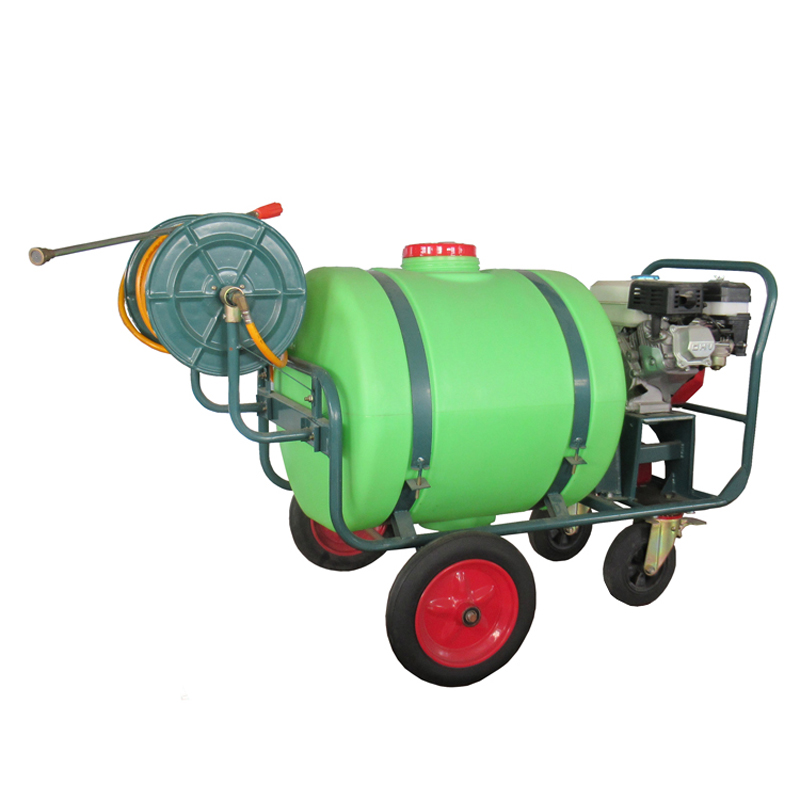
When payload weight exceeds safe human limits, you must shift to a wheeled chassis. Transitioning to a Trolley Power Sprayer is the standard operational upgrade for growing businesses. This equipment format offers several distinct operational benefits.
Extended Tank Capacity: Wheeled units typically feature tanks ranging from 10 to 50 gallons. You can spray continuously for hours without stopping to mix new batches.
Ergonomics and Safety: The chassis shifts the liquid weight from the operator's spine to the ground. This eliminates wearable weight hazards. It drastically lowers company liability regarding workplace ergonomics and injury claims.
Terrain Adaptability: High-quality wheeled units utilize large pneumatic tires. They also feature very low centers of gravity. This engineering allows operators to navigate deeply rutted agricultural terrain safely. It also makes moving across cluttered construction sites much easier.
Purchasing the correct unit requires analyzing several technical specifications. Do not buy a machine based solely on its price tag. You must match the internal components to your daily operational realities.
Many buyers focus entirely on PSI. This is a crucial mistake when buying a sprayer. Gallons Per Minute (GPM) serves as your most important metric. GPM dictates the actual speed of your operation. A higher GPM allows you to walk faster while maintaining proper coverage. PSI remains important only for physical reach. If you need to spray fungicides high into tall tree canopies, you need higher PSI. If you spray flat turf, high PSI only causes unwanted chemical drift.
The pump serves as the heart of your machine. You generally choose between two primary pump architectures.
Diaphragm Pumps: These pumps isolate the internal mechanics from the fluid. They handle abrasive liquids and wettable powders exceptionally well. They represent the industry standard for harsh agricultural chemicals.
Piston Pumps: These pumps offer higher PSI capabilities. They work best for pure, non-abrasive liquids. They push liquids further distances vertically.
Regardless of the pump style, you must verify the seal materials. Demand Viton® or equivalent chemically resistant seals. Standard seals will swell and leak within weeks of chemical exposure.
Your work environment dictates your power source. Each option provides distinct advantages.
Gas-Powered: Gas engines offer maximum mobility. They provide sustained, high-torque power for remote outdoor locations. They remain the top choice for large agricultural fields and off-grid landscaping.
Battery and Electric: Lithium-ion battery units now deliver impressive runtimes. You must use battery or electric power for indoor greenhouse applications. They are also mandatory for enclosed warehouses and noise-restricted urban environments. Gas fumes pose severe lethal risks indoors.
Consider the physical reach you need from the parked chassis. Long hose runs introduce friction loss. This reduces your final pressure at the nozzle. If you use a 100-foot hose, ensure the pump can push adequate GPM through that distance. Additionally, evaluate the hose reel integration. Dragging and coiling long, heavy hoses manually causes extreme frustration. A structurally integrated reel on the trolley chassis keeps the workspace organized and safe.
Owning commercial spraying equipment introduces specific maintenance responsibilities. Neglecting these realities will destroy your machine rapidly. You must establish strict daily operating procedures.
Using one machine for every chemical creates severe operational risks. You cannot easily switch between herbicides and liquid fertilizers. Trace amounts of herbicide clinging to the tank walls will kill the plants you intend to fertilize. Rinsing with plain water does not remove these chemical residues. You must use commercial-grade tank neutralizers between chemical swaps. Many professional operations simply buy separate machines. They dedicate one unit strictly to weed killers and another to fertilizers.
Freezing temperatures destroy fluid pumps. Water expands as it freezes into ice. This expansion cracks expensive pump housings instantly. You must winterize your machine before off-season storage. Drain all remaining chemicals properly. Flush the system with clean water. Finally, run RV antifreeze through the pump and hoses. The antifreeze displaces the water entirely. It protects internal seals and prevents catastrophic freezing damage.
Motorized equipment atomizes chemicals much finer than manual pumps do. Finer droplets stay airborne significantly longer. They drift easily toward the operator's face. This reality mandates upgraded personal protective equipment. Basic dust masks offer zero protection against atomized chemical vapor. Operators must wear proper dual-cartridge respirators. They also require chemical-resistant gloves and dermal protection suits. Never underestimate the inhalation hazards created by pressurized spraying.
Procuring a motorized sprayer drastically improves liquid application efficiency. You must base your procurement logic on clear operational requirements. Always align your intended chemical application with the correct internal pump materials. Never sacrifice seal quality when handling caustic substances.
As your liquid payloads increase, you must scale your transport methods accordingly. Upgrading to a wheeled chassis optimizes labor hours and protects your workforce from physical injury.
Review your chemical spec sheets carefully today. Calculate your required tank capacity based on your average daily acreage or square footage. Finally, consult directly with an equipment specialist to verify complete pump compatibility with your chosen chemicals.
A: We strongly advise against this. Power sprayers lack the high PSI necessary to remove stuck-on road grime or concrete stains effectively. Furthermore, if you previously used the unit for agricultural chemicals, residual toxic traces could permanently damage your vehicle's clear coat or contaminate residential storm drains.
A: Reach depends entirely on the pump's PSI rating and your selected nozzle. High-pressure piston pumps can shoot a vertical stream 25 to 30 feet into tree canopies. Horizontal reach extends further, though long hose lengths (over 100 feet) will slightly reduce pressure due to internal friction loss.
A: A diaphragm pump uses a flexible membrane to move fluid, isolating the mechanical parts from the liquid. This makes it perfect for abrasive chemicals and wettable powders. A piston pump uses a sliding cylinder, which generates higher pressure but is easily damaged by abrasive particulate matter.
A: You must perform a standard triple-rinse protocol. First, flush the tank and lines with clean water. Second, circulate a commercial liquid tank neutralizer or ammonia solution through the system to break down chemical bonds. Finally, perform a third flush with clean water to remove the neutralizer completely.


