
Views: 0 Author: Site Editor Publish Time: 2026-07-24 Origin: Site


A trailer sprayer is a wheeled, towable liquid application system. Professionals use it to distribute fertilizers, herbicides, and pesticides. It covers medium-to-large acreage effectively. Scaling up from a simple backpack sprayer presents new operational challenges. You must carefully balance tank capacity, pump specifications, and terrain limitations. Ignoring these critical factors causes uneven chemical application. It also frequently leads to premature hardware failure.
We designed this guide to deconstruct various sprayer configurations. It establishes clear baseline technical criteria for your purchasing journey. You will learn how to evaluate different tow-behind options objectively. You will discover a reliable framework for matching equipment to your specific operational needs. This knowledge helps you make confident, data-driven equipment investments.
Core Function: Trailer sprayers automate broad-area liquid application by relying on an external towing vehicle (ATV, UTV, or lawn tractor) and a 12V or gas-powered pump.
Design Variations: Options range from compact residential trolley power sprayers to 300+ gallon agricultural trailers.
Buying Logic: Purchasing decisions should be driven by pump Flow Rate (GPM), tank material durability, and the specific terrain's width restrictions, not just total liquid capacity.
Understanding trailer sprayer anatomy helps you make smarter purchasing decisions. Each component plays a vital role in overall field performance. We break down the four primary mechanical systems below.
Structural integrity remains non-negotiable for towable equipment. A powder-coated steel frame resists harsh chemical corrosion over time. It also handles the severe dynamic load of sloshing liquid safely. Standard pin-hitch compatibility matters greatly for operational flexibility. A standard pin setup lets you quickly attach the unit to multiple utility vehicles.
You should always look for UV-resistant polyethylene tanks. Direct sunlight degrades inferior plastics rapidly. Sump bottoms serve as a mandatory feature for modern tanks. They allow complete liquid drainage during the cleaning process. Larger models holding 200 gallons or more require internal baffles. Baffles stop severe liquid momentum during transit. They prevent the heavy trailer from tipping over during sharp turns.
On-demand diaphragm pumps serve as the mechanical heart of the system. Standard 12V electrical pumps draw power directly from your towing vehicle battery. They work perfectly for standard acreage and general maintenance. Standalone gas-engine pumps provide independent mechanical power. You need gas engines for high-volume, continuous agricultural applications.
Delivery mechanisms dictate your application accuracy. Fixed-width boom arms ensure precise, highly controlled coverage. They drop chemicals evenly right onto flat turf. Broadcast boomless nozzles shoot liquid outward horizontally. They work best for rough, obstacle-heavy terrain. Most premium units also include spot-spraying hand wands. Hand wands let you target isolated weeds precisely from the driver's seat.
Manufacturers categorize towable sprayers based on mobility and intended vehicle pairing. Understanding these categories prevents severe equipment mismatches.
Standard trailer models pair best with ATVs, UTVs, and heavy-duty zero-turn mowers. They provide the ideal solution for one-to-five acre plots. Food plot managers rely on them heavily for seasonal prep. They manage large-scale weed problems efficiently. You connect them directly via a standard rear tow hitch.
You should also consider this closely related mobile variation. It features a highly maneuverable, two-to-four-wheel compact cart design. Many models include a self-contained battery and internal motor. You can easily push or pull them by hand. They excel in tighter spaces like commercial nurseries and retail greenhouses. Small urban gardens benefit immensely from their minimal footprint. You can also tow a Trolley Power Sprayer behind smaller residential lawn tractors.
You must match the equipment directly to your vehicle's safe towing capacity. You must also consider the physical constraints of your application area. Gate widths often dictate your maximum safe boom span. Row spacing in nurseries determines your maximum wheel track width. Measure your property constraints before evaluating tank sizes.
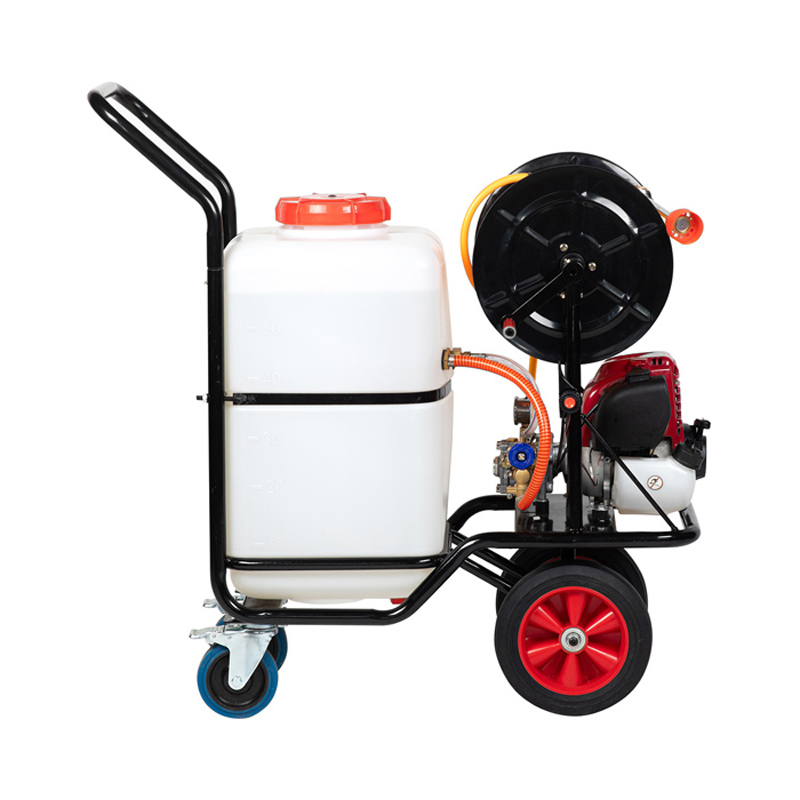
Superficial features distract buyers from core performance metrics. You must evaluate sprayers based on strict mathematical and structural criteria.
Sizing the tank requires a conservative calculation framework. A massive tank causes severe soil compaction. It constantly strains your towing vehicle engine. However, a tiny tank drastically increases refill downtime. You lose valuable operational hours driving back to the water source.
Tank Sizing and Acreage Recommendations
Property Size |
Recommended Tank Capacity |
Ideal Towing Vehicle |
|---|---|---|
Up to 1 Acre |
15 - 25 Gallons |
Lawn Tractor / Ride-on Mower |
1 to 3 Acres |
25 - 40 Gallons |
Standard ATV |
3 to 5 Acres |
40 - 60 Gallons |
Heavy-duty ATV / Small UTV |
5+ Acres |
100+ Gallons |
Full-size UTV / Compact Tractor |
Buyers often misinterpret pump specifications. You must differentiate between volume and pressure correctly.
Gallons Per Minute (GPM): GPM dictates your maximum boom width and total nozzle output. A 2.2 GPM pump runs a standard two-nozzle boom. A 5.0 GPM pump easily supports a seven-nozzle boom or a high-volume boomless system.
Pounds Per Square Inch (PSI): Many operators believe higher PSI automatically means better performance. This misconception causes serious application errors. High PSI creates microscopic droplets. Wind easily blows these tiny droplets off target. Stable, regulated PSI ensures uniform droplet size. Uniform droplets fall directly onto the intended foliage.
Interchangeable nozzles serve as a critical feature. AIXR (Air Induction Extended Range) and flat fan nozzles adapt to different chemical viscosities. Air induction nozzles pull air directly into the liquid droplet. The droplet becomes larger and heavier upon exit. It falls straight down and resists wind drift effectively. Standardizing your nozzle caps allows rapid field adjustments.
Standard parts break down eventually due to friction and chemical exposure. Valves, hoses, and pressure gauges wear out over multiple seasons. Manufacturers should use universal threaded fittings. Avoid brands relying exclusively on proprietary quick-connect parts. Proprietary lock-in forces you into expensive, delayed replacements. You want off-the-shelf compatibility for immediate field repairs.
Field implementation exposes equipment to harsh realities. Proper maintenance prevents catastrophic hardware failures during the busy season.
Agricultural chemicals act aggressively on internal components. Harsh wettable powders act like liquid sandpaper inside the pump. They chew up standard rubber diaphragms rapidly. Standard EPDM rubber cannot survive commercial herbicide mixtures. We highly recommend upgrading to chemical-resistant seals. Santoprene or Viton materials handle abrasive and corrosive mixtures beautifully.
Freezing temperatures destroy unprotected pumps overnight. Expanding ice cracks manifolds and ruins expensive valves. You must winterize your equipment proactively.
Drain all remaining liquid from the tank.
Flush the entire system thoroughly using clean water.
Pour RV antifreeze directly into the empty tank.
Run the pump until pink antifreeze exits every nozzle.
Skipping these steps guarantees a cracked pump next spring.
An uncalibrated sprayer acts as a major operational liability. You cannot guess your application rate safely. Users must perform pure water test runs first. You must match your vehicle speed strictly to the pump pressure. You must also verify the actual nozzle output volume. This specific combination dictates your final application rate. Over-application damages delicate crops and wastes expensive chemicals. Under-application leaves target weeds completely unaffected.
Follow a strict, logical progression when comparing different models. This prevents emotional purchases based on aggressive marketing.
Check your towing vehicle's maximum safe towing capacity first. Look directly at the manufacturer's owner manual. Water weighs approximately 8.3 pounds per gallon. A 60-gallon tank adds 500 pounds of liquid weight instantly. You must also factor in the empty weight of the steel chassis.
Your physical terrain dictates your ideal delivery system.
Application Style Comparison
Terrain Type |
Recommended Setup |
Primary Advantage |
|---|---|---|
Flat, Open Turf |
Folding Boom System |
Maximum application precision |
Wooded, Uneven Pastures |
Boomless Broadcast Nozzles |
Zero risk of snapping metal arms |
Tight Greenhouses/Nurseries |
Trolley Setup |
Exceptional hand-maneuverability |
Choose boom sprayers for flat, obstacle-free turf. Choose boomless models for uneven pastures or dense wooded perimeters. Opt for a Trolley Power Sprayer for high-maneuverability environments.
Ensure your chosen pump rates high for chemical corrosiveness. Tanks and hoses must handle the specific chemicals you plan to spray. Corrosive fertilizers require heavy-duty stainless steel or poly components. Avoid systems utilizing exposed mild steel near the primary liquid pathways.
A trailer sprayer boosts your liquid application efficiency dramatically. It replaces exhausting manual labor and ensures consistent ground coverage. Buyers must prioritize structural chassis durability above all else. Pump quality and precise vehicle matching matter much more than superficial aesthetic features.
Take immediate action before making a purchase. Audit your utility vehicle's exact towing capacity today. Measure your narrowest property gates and field entryways carefully. Verify the spacing between your garden rows. Complete these physical measurements before reviewing specific product spec sheets.
A: Yes, but you must check your mower’s transmission rating first. You also need to calculate the filled weight of the sprayer. Water weighs over eight pounds per gallon. Overloading your mower risks catastrophic hydrostatic transmission failure. Always consult your operator's manual before attaching heavy tow-behind equipment.
A: Booms use multiple nozzles mounted on folding metal arms. They provide precise, wind-resistant liquid coverage. Boomless systems rely on one or two high-powered nozzles. They shoot a wide swath horizontally. This design proves ideal for navigating around trees and fences. However, boomless setups remain highly susceptible to wind drift.
A: Generally, no. Manufacturers design them for localized, high-mobility tasks. Nursery management and greenhouse spot-spraying represent ideal use cases. Residential landscaping also benefits from their compact footprint. They lack the liquid capacity and structural width necessary for broad-acre field agriculture.
A: You must triple-rinse the entire system immediately after use. Mix a commercial tank neutralizer during your first rinse cycle. Flush the pump and all hoses thoroughly with clean water. Proper cleaning prevents severe chemical cross-contamination. It also stops harsh chemicals from rapidly degrading your pump seals.


