
Views: 0 Author: Site Editor Publish Time: 2026-08-16 Origin: Site


Upgrading from manual spraying to an efficient mechanized system forces you to balance coverage area, labor constraints, and local terrain. This transition acts as a crucial operational bottleneck for modern agricultural and landscaping managers worldwide. Choosing the wrong power sprayer type leads directly to severe operator fatigue. You also risk wasting valuable chemical inputs through uneven application. Furthermore, inadequate equipment often delivers insufficient pressure for proper canopy penetration in dense foliage. These structural inefficiencies severely limit your daily yield and compromise crop protection efforts. This guide breaks down the core categories of power sprayers available today. We will outline objective evaluation criteria to help you confidently compare the available options. You will learn exactly how to match the right equipment to your specific operational scale, helping you eliminate physical strain and maximize daily application rates.
The choice of power sprayer hinges on three primary constraints: terrain type, required tank capacity, and operator fatigue limits.
Trolley power sprayers provide the highest capacity-to-mobility ratio for flat or semi-flat terrains, eliminating the physical strain of backpack models.
Backpack and portable stationary sprayers remain necessary for uneven, steep, or highly confined agricultural environments.
Selecting the right power source (battery vs. 2-stroke/4-stroke engine) directly impacts maintenance overhead and operational compliance.
Evaluating a new spraying system usually begins when manual methods fail to meet operational demands. Moving beyond manual pump sprayers becomes necessary to achieve continuous pressure. Hand-pumping inherently causes pressure fluctuations. These fluctuations alter droplet sizes and result in uneven chemical distribution. You need higher PSI to reach tall canopies and consistent droplet sizes to prevent chemical drift.
To evaluate a new power sprayer effectively, you must define clear objectives. We recommend measuring your equipment choice against three core success criteria:
Efficiency: You must drastically reduce the time spent refilling tanks. Small tanks demand constant trips back to the mixing station. This downtime kills daily productivity. High-capacity tanks keep operators in the field longer.
Efficacy: You need uniform chemical and fertilizer application. Power sprayers eliminate pressure drops. They maintain a steady flow rate from the first gallon to the last. This consistency ensures reliable pest and weed control.
Labor Economics: You should prioritize minimizing operator fatigue. A worker carrying heavy equipment loses efficiency rapidly. Sustaining high productivity over an 8-hour shift requires ergonomic solutions. Heavy manual loads increase the risk of workplace injuries.
Backpack power sprayers represent the most common entry point into mechanized application. They feature an engine or battery mounted directly to a 15–25 liter tank. The operator wears this entire unit on their back using padded harness straps. They deliver reliable atomization without the need for manual pumping.
These units excel in difficult environments. They are best for steep terrains, muddy fields, and tight agricultural rows. When wheels cannot navigate a narrow pathway, a backpack unit provides necessary mobility. Operators can walk through dense brush or climb terraced hillsides easily.
However, you must consider the physical trade-offs. They cause high operator fatigue. A fully loaded 25-liter sprayer weighs over 60 pounds. Carrying this weight stresses the lower back and shoulders. Additionally, the limited tank capacity requires frequent refilling. You will spend considerable time walking back to the supply tank.
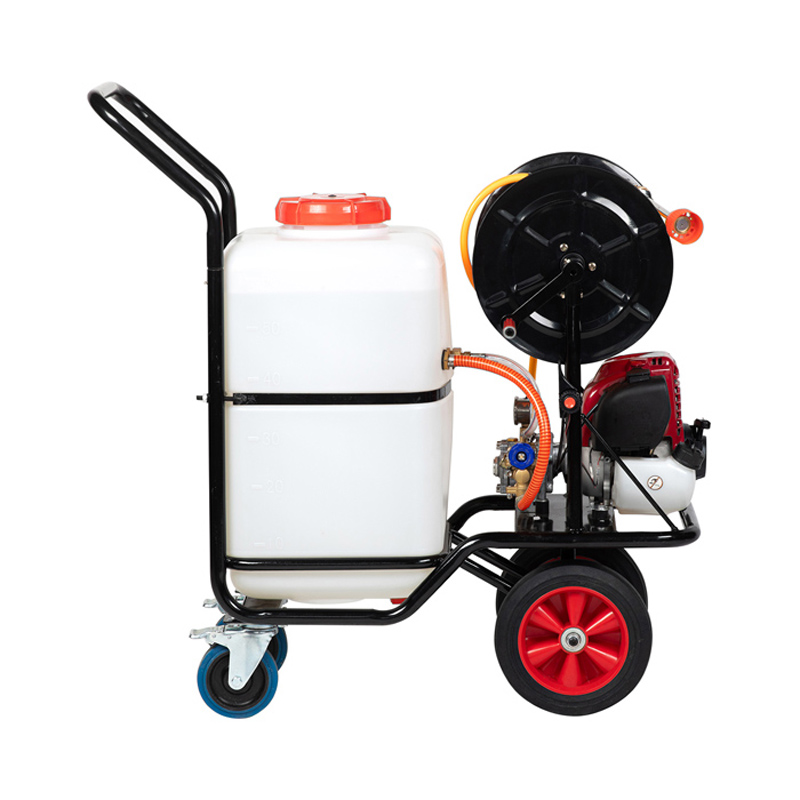
If flat ground dominates your operation, wheeled designs offer massive operational advantages. These systems feature high-capacity tanks, typically holding between 50 and 100+ liters. They sit on a wheeled chassis alongside an integrated pump and power source. This design entirely removes the weight from the operator's back.
They are exceptionally well-suited for specific environments. They are best for greenhouses, flat orchards, commercial nurseries, and large-scale hardscaping projects. The operator simply pulls or pushes the cart along accessible pathways. For operations prioritizing ergonomics, a Trolley Power Sprayer dramatically increases the amount of liquid applied per hour.
The primary trade-offs involve terrain limitations. They are highly ineffective on uneven, steep, or deeply rutted terrain. Small wheels easily mire in deep mud. You cannot drag them over large rocks or fallen branches safely.
Portable or stationary power sprayers decouple the pump from the tank. They feature a standalone engine and pump unit built into a carrying frame. They do not have a built-in reservoir. Instead, they draw liquid from a separate stationary drum and push it through hundreds of feet of high-pressure hose.
These systems are best for orchards or heavily wooded hilly terrain. The heavy liquid reservoir and pump remain stationary on a truck bed or flat ground. Meanwhile, the operator moves freely among the trees carrying only the spray wand and hose. This provides immense volume capacity without sacrificing human mobility.
The trade-offs primarily center around hose management. Pulling heavy, pressurized hoses requires physical exertion. You face a high potential for hose snagging or damage in dense crops. Dragging hoses over delicate plants can also cause unintended crop damage.
Tractor-mounted sprayers dominate commercial agriculture. They utilize PTO-driven (Power Take-Off) or standalone engine pumps. Operators attach them to utility vehicles or pull them behind tractors. They support massive tank capacities ranging from 200 to over 1000 liters. Boom attachments allow them to cover multiple crop rows simultaneously.
They are best for broad-acre farming and large commercial agricultural operations. Nothing beats a trailed sprayer for covering vast expanses of open land quickly. They provide unmatched volume and pressure capabilities.
However, you must accept certain trade-offs. They require a high capital investment. Furthermore, they demand specific field layouts. You need wide, navigable rows and large turning radiuses to operate them safely. They are entirely unsuited for confined spaces.
Choosing the right sprayer requires mapping technical features to your daily operational outcomes. You cannot rely on maximum pressure ratings alone. You must balance mobility, pressure requirements, and power sources against your specific terrain.
You face a constant battle between carrying more liquid and navigating physical terrain limits. Larger tanks reduce refill trips. However, they drastically decrease mobility. You must evaluate how much water weight your terrain can realistically support.
Sprayer Category | Average Capacity | Mobility Level | Ideal Terrain Capability |
|---|---|---|---|
Backpack | 15 - 25 Liters | Very High | Steep inclines, deep mud, dense brush |
Wheeled / Cart | 50 - 100+ Liters | Medium | Flat paths, greenhouse aisles, pavement |
Stationary / Hose | 200+ Liters (Drum) | High (Operator only) | Hillsides, established orchards, uneven ground |
Tractor-Trailed | 200 - 1000+ Liters | Low (Requires vehicle) | Broad-acre fields, wide row crops |
You must map pressure specifications directly to your coverage needs. Pressure, measured in PSI or Bar, determines how far the liquid travels and how finely it atomizes. Flow rate determines the total volume delivered per minute.
High PSI is absolutely required for tall tree canopy penetration. You need enough force to push fine mist through dense outer leaves to reach the inner branches. Conversely, lower pressure is better for standard weed control. High pressure creates tiny droplets prone to drifting into unintended areas. Low pressure creates larger, heavier droplets. They fall directly onto the targeted weeds safely.
The engine driving your pump dictates your maintenance schedule and working environment. You generally choose between internal combustion and electric battery power.
Gasoline (2-stroke/4-stroke): Gas engines deliver higher continuous power and peak pressure. They excel in remote fields where recharging is impossible. However, they require strict fuel management and engine maintenance. They also emit toxic exhaust fumes. This makes them strictly unsuitable for enclosed greenhouses or poorly ventilated spaces.
Battery/Electric: Lithium-ion technology has revolutionized spraying. Battery units offer dramatically lower maintenance. You never clean a carburetor or mix oil. They operate quietly and produce zero emissions. They represent the perfect choice for indoor or urban operations. Their main limitations are battery life spans and potentially lower peak PSI compared to commercial gas engines.
Technical specifications tell only half the story. Field realities often dictate the true success of agricultural equipment. You must anticipate physical limitations and maintenance bottlenecks before deploying new units.
You must acknowledge the harsh reality of wheeled units. Carts require stable, relatively flat ground. Deploying one in deep, sticky mud will stall your operations immediately. The wheels will sink, rendering the unit immovable. Similarly, pushing a heavy cart up steep inclines risks tipping and chemical spills. You must realistically survey your paths before choosing a wheeled solution.
Mechanized equipment demands rigorous upkeep. Gas-powered pumps require regular oil changes, spark plug replacements, and carburetor cleaning. You must also perform thorough winterization to prevent freezing damage. More importantly, pump hygiene is critical. Failure to flush pumps with clean water after using wettable powders leads to immediate seal degradation. Dried chemical residues destroy internal diaphragms rapidly, causing costly downtime.
Ergonomics directly impact your labor force. Heavier equipment risks operator injury if you ignore basic ergonomic guidelines. A fully loaded 25L backpack sprayer places immense vertical compression on the spine. Operators often lean forward to compensate, causing lower back strain. Transitioning to wheeled or stationary systems mitigates this physical risk entirely. When operators experience less pain, they maintain steady application speeds throughout their shifts.
Matching equipment to your farm or facility does not need to be overly complicated. Apply this straightforward shortlisting logic to narrow down your choices rapidly:
If Terrain is Steep/Uneven + Small Scale: Opt for a Backpack Power Sprayer. The physical terrain forces you to prioritize human mobility over tank capacity. You must accept the frequent refill trips to navigate the hills safely.
If Terrain is Flat/Accessible + Medium-to-Large Scale: Opt for a Trolley Power Sprayer. You want to maximize tank size while completely eliminating back strain. The wheels do the heavy lifting, allowing sustained spraying in nurseries or flat fields.
If Terrain is Difficult + Large Scale: Opt for a Portable/Stationary Sprayer with extended hoses. You need massive volume but cannot drive a tractor through the area. Station the tank on a nearby road and pull the hose to the target zones.
If Broad-Acre / Open Field: Opt for a Tractor-Mounted/Trailed unit. Human-carried or pushed equipment cannot economically cover dozens of acres. You must leverage vehicle speed and wide boom attachments.
Selecting a power sprayer is not just about choosing the highest PSI or the largest tank on the market. It requires a realistic assessment of your local terrain, available labor force, and specific crop type. Misaligning these factors leads to broken equipment, exhausted workers, and poor chemical application.
Evaluating the physical toll on your operators should be weighed equally with technical specifications. Fatigue causes mistakes. For operations featuring accessible pathways or level ground, shifting from backpacks to wheeled units is often the highest-ROI upgrade you can make. It protects your workers while doubling application capacity.
Take immediate action by reviewing specific equipment spec sheets against your field realities. Measure your row widths to ensure carts or tractors can pass easily. Contact an agricultural sales engineer to match your required flow rates with the correct pump capacity today.
A: A manual knapsack requires the operator to continuously pump a lever to build pressure. This causes fluctuating pressure and operator fatigue. A power sprayer uses a gas engine or electric battery to drive the pump. It delivers continuous, uniform pressure and automated atomization without any manual pumping.
A: Yes, they are highly effective for indoor greenhouses. However, you must select battery-operated electric models. Gas-powered engines emit toxic carbon monoxide fumes and create excessive noise, making them unsafe for enclosed environments. Electric units comply with zero-emission and low-noise requirements perfectly.
A: Orchard spraying typically requires high pressure for proper canopy penetration. You generally need a baseline range of 150 to 300+ PSI. This high pressure atomizes the liquid into a fine mist. The mist travels upward and pushes through thick outer foliage to coat interior branches and leaves.
A: Daily maintenance involves flushing the pump and hoses with clean water to remove chemical residues. You must also clean inline filters to prevent clogs. For gas models, routine engine servicing includes checking oil levels, cleaning air filters, and inspecting spark plugs. Regularly inspect pump seals for leaks.


