
Views: 0 Author: Site Editor Publish Time: 2026-03-04 Origin: Site


When growers ask “which tool is used for spraying in agriculture?”, they usually want a practical answer—one that matches real working conditions: field size, crop height, labor availability, terrain, and how often spraying happens during the season. From our experience supplying sprayers to different farm types, most spraying tasks can be covered effectively with four core product families: Knapsack Power Sprayers, Portable Power Sprayers, Frame Power Sprayers, and Trolley Power Sprayers. Each type is built around a different workflow—on-back mobility, hand-carried flexibility, higher-flow stationary spraying, or easy-rolling large-capacity support.
In this guide, we’ll explain what each sprayer type is used for, how to choose based on your farm reality, and what practical details (pressure, flow, hose, and maintenance) matter most—so you can spray more evenly, waste less chemical, and finish jobs faster with consistent coverage.
Here’s a quick overview of the four sprayer types and how they differ:
Sprayer Type | Typical Setup | Best For | Key Advantage | Trade-Off |
Knapsack Power Sprayers | Engine/motor unit worn on back | small farms, orchards, hills | maximum mobility | operator carries the weight |
Portable Power Sprayers | Hand-carried pump unit + hose | spot-to-medium spraying | flexible & easy to move | smaller tank / needs water nearby |
Frame Power Sprayers | Pump on metal frame (ground-based) | continuous high-output spraying | stable, higher flow options | less mobile; needs placement |
Trolley Power Sprayers | Pump + tank on trolley wheels | medium-to-large areas | large capacity + easy movement | needs relatively passable ground |
If you only remember one thing: the “right” tool is the one that keeps your spray pressure steady and your operator efficient for the whole job—not just the first 10 minutes.
Knapsack power sprayers are designed for farms where the operator needs to move freely across rows, slopes, terraces, or orchard blocks. They are often chosen for:
orchards and vineyards
vegetable fields with narrow paths
hilly or uneven terrain
farms that need quick spot-to-spot spraying
True portability: you don’t need to drag a trolley or find a flat position.
Consistent output: compared to manual pumping, power assistance helps maintain steadier pressure.
Good reach: with the right lance/nozzle, they can deliver targeted spraying to canopy zones.
Choose a harness that distributes weight well (comfort affects spraying quality).
Match engine/motor power to your required pressure and spray distance.
Pick hose/lance length based on crop height and row spacing.
Portable power sprayers are compact pump units that can be carried and set down quickly, then used with a hose and spray gun/lance. They are a strong fit when:
you spray multiple small zones (field edge, greenhouse perimeter, nursery area)
the farm has a water source nearby
you need a sprayer that one person can move easily without wearing it
mixed crops and small plots
spot spraying and targeted treatment
farms that want power spraying without a heavy tank system
Portable units usually rely on a separate water container/tank or nearby supply. That’s why they work best when you have stable access to water and you’re not walking long distances.
Frame power sprayers place the pump on a sturdy metal frame so it can run stably on the ground. This type is popular for farms that need:
higher flow rates for longer continuous spraying
multiple hoses or longer hose runs
more stable performance during long work sessions
row crops with long spray runs
orchards where operators spray from a stable point
farms that want to connect to a larger external tank
A stable base reduces vibration and helps protect the pump, especially when running for longer periods. It also simplifies operation when multiple workers are involved (one manages the pump, others spray through hoses).
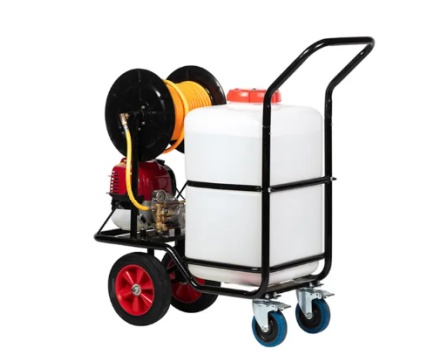
Trolley power sprayers combine pump + tank on wheels, giving you capacity without forcing the operator to carry weight. They are commonly used for:
medium-to-large farm blocks
longer spraying sessions
farms that want fewer refills
facilities where paths are relatively passable (farm roads, orchard lanes)
Large tank support reduces downtime from refilling.
Better workflow for teams: one person can move the trolley while another sprays.
Less operator fatigue compared to knapsack carrying on long jobs.
If the field is very muddy or highly terraced, a trolley may be inconvenient. In that case, knapsack power sprayers often win for mobility.
We recommend selecting agricultural sprayers by answering four practical questions. This approach is simple, but it prevents the most common buying mistake: choosing a sprayer by “power” or “tank size” alone, then realizing the workflow doesn’t fit your farm. The right sprayer is the one that keeps pressure stable, coverage consistent, and operator fatigue low from the first row to the last.
Start with mobility, because it determines everything else.
Lots of walking / hills → Knapsack Power Sprayers
Best when you must climb slopes, move through terraces, or spray narrow orchard paths where wheels are inconvenient.
Moderate movement, water nearby → Portable Power Sprayers
Ideal for mixed tasks around a greenhouse, nursery, or small plots where you can carry the unit and work in shorter zones.
Mostly one place, long hose work → Frame Power Sprayers
Great if you prefer placing the pump in one stable position and spraying through longer hoses, especially for continuous work.
Rolling paths, bigger zones → Trolley Power Sprayers
The most efficient choice when lanes are passable and you want capacity + mobility without carrying weight.
Refill frequency affects efficiency more than many people expect.
Yes → Trolley Power Sprayers or Frame Power Sprayers + larger tank
No / small area → Knapsack or Portable (quick setup, minimal equipment)
Match the sprayer to your daily routine.
Short sessions → Portable or Knapsack (fast start, easy movement)
Long sessions → Frame or Trolley (better efficiency, less fatigue, smoother output)
Your target shape determines pressure, reach, and coverage needs.
Tall canopy & vertical targets → choose a type that supports your required pressure and lance reach, commonly knapsack or frame systems depending on movement needs.
Low crops & rows → prioritize stable flow and a comfortable walking pace; portable or trolley units often improve consistency.
Scenario | Best Recommended Type | Why |
Terraces, hills, narrow orchard paths | Knapsack Power Sprayers | maximum mobility |
Greenhouse edges, nursery zones, mixed small tasks | Portable Power Sprayers | easy to carry and set down |
Long continuous spraying, multi-hose work | Frame Power Sprayers | stable output, supports longer runs |
Medium-large fields with passable lanes | Trolley Power Sprayers | larger capacity, lower fatigue |
No matter which type you choose, reliability comes from simple habits:
Rinse and flush after spraying (prevents residue buildup)
Clean filters/nozzles regularly
Check hose connections for leaks
Store dry and protected from direct sun
Use clean water to reduce clogging and pump wear
A good sprayer can last many seasons—if the operator treats cleaning as part of the job, not an afterthought.
So, which tool is used for spraying in agriculture? In day-to-day farming, the most practical answers often fall into four dependable categories: Knapsack Power Sprayers, Portable Power Sprayers, Frame Power Sprayers, and Trolley Power Sprayers. Each one is built for a different spraying workflow—mobility, flexibility, stable high-output, or large-capacity movement. The “best” sprayer is the one that fits your field reality and keeps your pressure, coverage, and operator comfort consistent from start to finish.
At Taizhou Kesiwo Garden Tools Co., Ltd., we focus on producing agricultural sprayers that are designed for real farm work—stable performance, practical configurations, and durable components that support efficient spraying across different crops and farm sizes. To explore suitable models and options for your application, you’re welcome to learn more and contact us through Taizhou Kesiwo Garden Tools Co., Ltd.
Knapsack power sprayers are usually best because they provide mobility on slopes and narrow paths without needing wheels or a fixed position.
A trolley power sprayer offers larger capacity with less operator fatigue, helping reduce refills and improve efficiency in medium-to-large areas.
Choose a frame power sprayer when you need stable, continuous spraying output, longer hose runs, or multi-hose operation from a fixed point.
Yes. Portable power sprayers are flexible and easy to move for mixed small tasks, especially when a water source is available nearby.


